Michael Harding Watercolour Painting Prize – August 2025
The opening of the group show Pearlescent (organised by Artists Studio Company, London) was a great fun and I am very grateful to have unexpectedly won the Michael Harding Watercolour Painting Prize, particularly because I have only recently re-started painting after a very long time of a strongly drawing-focused practice.
This makes me incredibly happy.
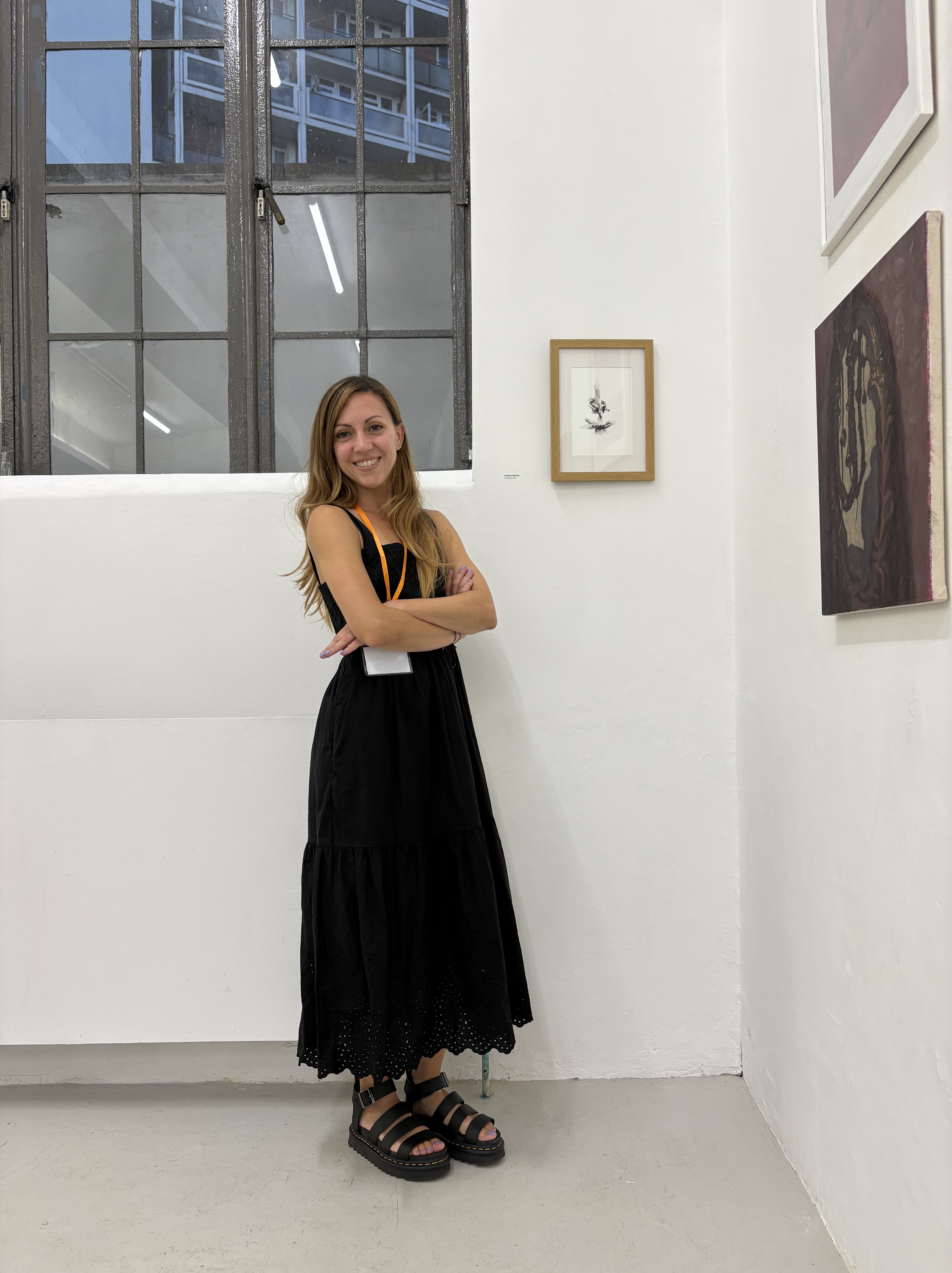
I am thrilled to had the opportunity to present one piece from a brand new body of work (that is still very much in progress).
Changing is always scary, but I am embracing my new work with openness, curiosity, trust and enthusiasm and I am glad to finally share one piece from the watercolour series Vibrations.
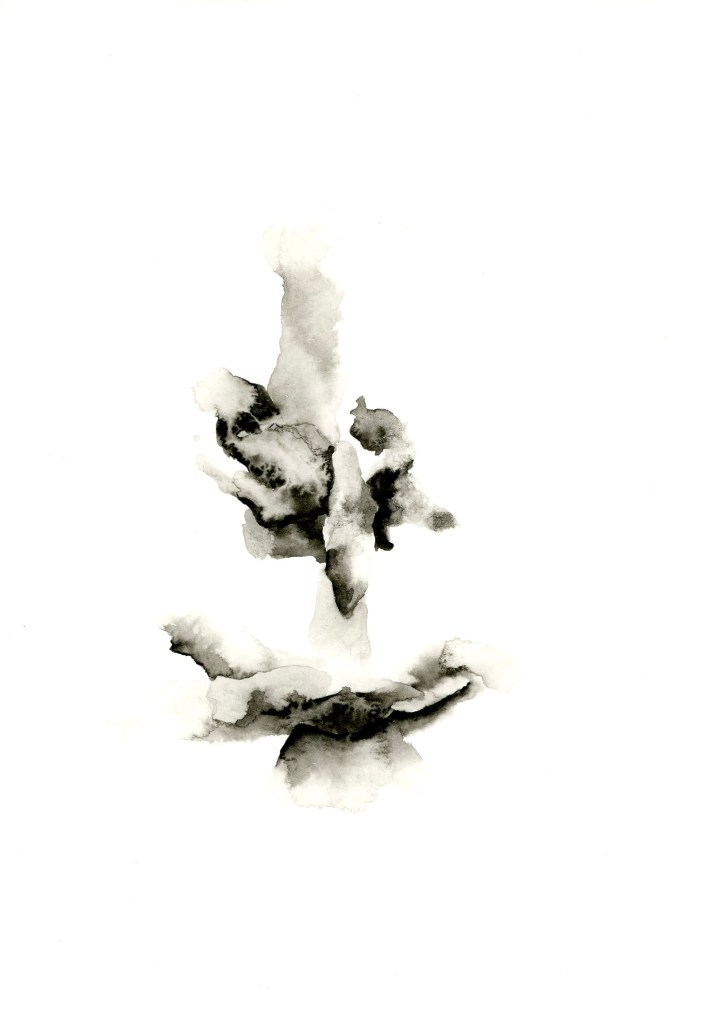
Vibration #12
Watercolour on paper
14.8 cm x 21 cm
2025
The exhibition will remain open until 29 August at
the Handbag Factory
3 Loughborough St, London SE11 5RB.
Open every day 10am – 5pm, FREE ENTRY
Pearlescent – July 2025
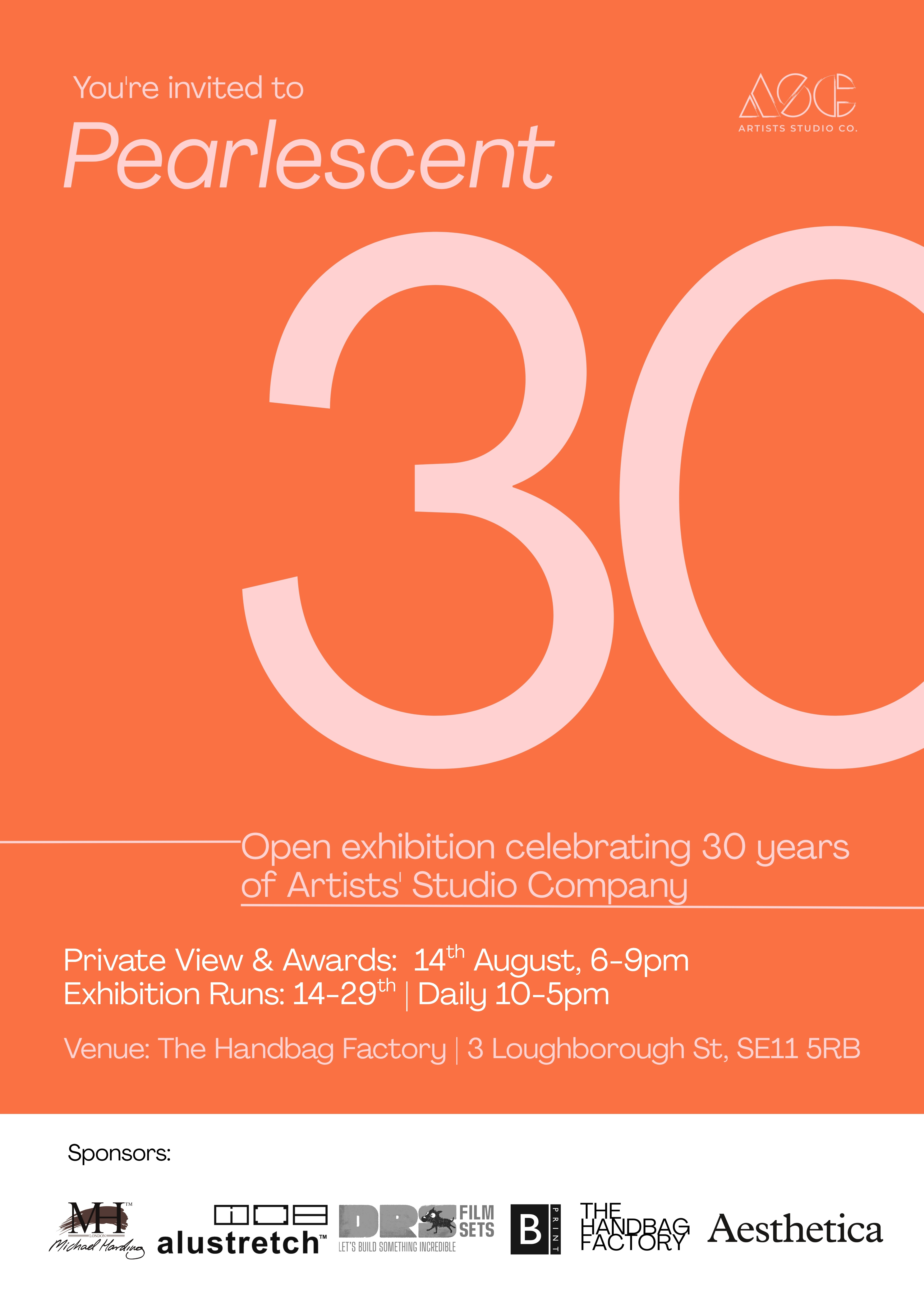
I’m very excited to be taking part in Pearlescent and truly honoured that my work has been selected as part of this project celebrating the 30th anniversary of ASC London.
Especially during times when life doesn’t go as planned and things feel uncertain, it means a lot to be part of such a vibrant and supportive community of artists.
I’m also thrilled to be presenting, for the very first time, a piece from my new body of work. Since February, I’ve been working on something quite new to me, a process that is unfolding organically, yet still feels mysterious and challenging in many ways.
It would mean a lot to receive your thoughts and impressions, so I warmly invite all of you to join the Pearlescent private view on
14 August, 6-9 pm.
The Handbag Factory, 3 Loughborough St, London SE11 5RB.
Hope to see you there!
The exhibition will remain open until 29 August,
every day from 10 am to 5 pm (free entry).
What’s Past is Prologue – May 2025
Four paintings – each a delicate conglomerate of pen strokes, white paint, memories and
shadows. Windows into a time gone by yet still present, emerging through the grains of the
canvas. You begin to recognise forms and shapes, vaguely geometric, softly clouded.
Slowly, the shadows of an apartment materialise, its floor plan appearing in fragments. Walls
turning into feeble outlines marking pools of void, each corresponding to a room. Each room
is a drawer, a casket of memories, feelings and events – invisible to us but deeply familiar to
the artist. These contents, though unseen, construct an identity over time.
These are white paintings with countless colours and shades: ivory – snow – white smoke –
pearl – sea salt – ghost white. These paintings are ghosts – recollections from a past still
becoming – and clouds – hazy and vaporous like any history of oneself. These paintings are
pieces of a self-portrait: a map of the self, traced through the rooms of one’s flat.
The process of making is an act of uncovering, discovering and reconfiguring. First, the pen
strokes outline the floor map on the canvas; then, the brushstrokes patiently wash over the
drawn shapes. And yet, buried beneath coats of white paint, the rooms keep resurfacing. As
they reappear, they become something new – the whiter the image, the deeper the
understanding.
I look at them again and again, and now I can see new things. The walls and rooms start
turning into bones and joints; the floor plan becomes a body map. Cracks and fissures signal
fractures and scars, like in an X-ray image: the white picture of the artist’s self.

Quattro dipinti: ciascuno un delicato assortimento di tratti a penna, pittura bianca, ombre e
ricordi. Finestre su un tempo passato ma ancora presente, che emerge dalle tele granulose.
Si cominciano a riconoscere forme e composizioni, vagamente geometriche, dolcemente
offuscate. Lentamente si materializzano le ombre di un appartamento; compaiono i
frammenti della pianta di una casa. I muri si trasformano in contorni deboli che delimitano
campiture di vuoto, ognuna corrispondente a una stanza. Ogni stanza è un cassetto, uno
scrigno di ricordi, sentimenti ed eventi – a noi invisibili ma profondamente familiari all’artista.
Quel che contengono, benché impossibile da vedere, costruisce nel tempo un’identità.
Si tratta di dipinti bianchi dotati di innumerevoli tonalità e sfumature: avorio – bianco fumo –
bianco perla – sale marino – bianco impalpabile, spettrale. Questi dipinti sono spettri –
memorie di un passato ancora in divenire – e nuvole – vaghi e vaporosi come ogni storia di
se stessi. Sono pezzi di un autoritratto: una mappa del sé, tracciata mediante le stanze di
un appartamento.
Il processo di realizzazione è un atto di disvelamento, scoperta e riconfigurazione. Prima i
tratti della penna tracciano sulla tela il contorno della pianta; poi le pennellate inondano
pazientemente le forme disegnate. Eppure, sepolte sotto strati di pittura bianca, le stanze
continuano a riemergere in superficie. E mano a mano che riappaiono, diventano qualcosa
di nuovo – più bianca è l’immagine, più profonda è la consapevolezza.
Più li guardo e più scorgo nuove forme. I muri e le stanze si tramutano in ossa e
articolazioni; la piantina della casa diviene la mappa di un corpo. Crepe e fessure segnalano
fratture e cicatrici, come in una radiografia: l’immagine bianca dell’io dell’artista.
Federico Florian, 2025
Federico Florian is a London-based writer, editor and translator. His writing has been published in Art in America, Artforum, Elephant, Flash Art and The Art Newspaper. Recently, he translated The Turn to Provisionality in Contemporary Art by Raphael Rubinstein (Bloomsbury, 2023) into Italian. He is currently translating the latest publication by Claire Bishop, Disordered Attention (Verso, 2024).
Opening tonight – January 2025

Upcoming solo exhibition – December 2024

What’s Past is Prologue is my most intimate body of work.
In here I used my own apartment in London as a main and recurring subject. The work it’s about the emptiness, physical as well as emotional, experienced after a loss, and an attempt to deal with the void as a survival mechanism. The negative space of anyone’s home is what allows one to actively in-habit and to shape the emptiness of the house, as well as of their own existence.
Houses allow the active action of inhabiting, providing rooms and boundaries; and in turn their dwellers see their movements, actions, thinkings and emotions shaped from them, from the available space, from the geometry of every corner.
What’s Past is Prologue is an attempt to analyze this reciprocal relation between the domestic space and the inner space, but also to come to terms with the endings. Houses are places of experiences, witnesses of events, custody of memories, safe shelters, suffocating cages. This personal reflection of the inside/outside, is a way to complete a painful process of self-discovery and healing, in strong connection with the apartment which was the set and the witness of changes and of a deep personal transformation. On an emotional as well on an artistic level, the strong use of the white acts as a purification process, a way to conclude a cycle of previous works and prepare for something new to evolve. The use of white painting is an instrument to erase and hide, rather than create and add. A patient process of overlapping allows the negative space to gently emerge on the canvas’ surface.
Drawing on tracing paper recalls the architecture practice, but here the focus is on filling the voids, rather than marking the structure. Working on the negative space of my apartment’s floor plant acts as an X Ray, a way to reduce the physicality of the space to the nothingness, keeping only the invisible space and discarding all the rest.
Forms disappear, evolve and fade covered by layers of white color, or emerge from the transparency of the paper, but only to suggest possible shapes, constantly playing with the ephemeral as a new way to interpret the world.
Federica Beretta 2024
* What’s past is prologue is a quotation from William Shakespeare’s play The Tempest, Act 2, Scene 1
Aesthetica Art Prize 2024 – Longlisted – January 2024
I am very happy to have been longlisted for this year’s edition of the Aesthetica Art Prize 2024, an annual event that celebrates contemporary art across a range of media.
As Longlisted Artist my work will be displayed digitally on screens which are placed alongside the finalists group exhibition. Although my work will not be physically present in the venue, I am grateful that my practice has been taken into consideration by the panel.
The exhibition will be open at the York Art Gallery, UK from 16 February 2024.

Guildford House Open – November 2023
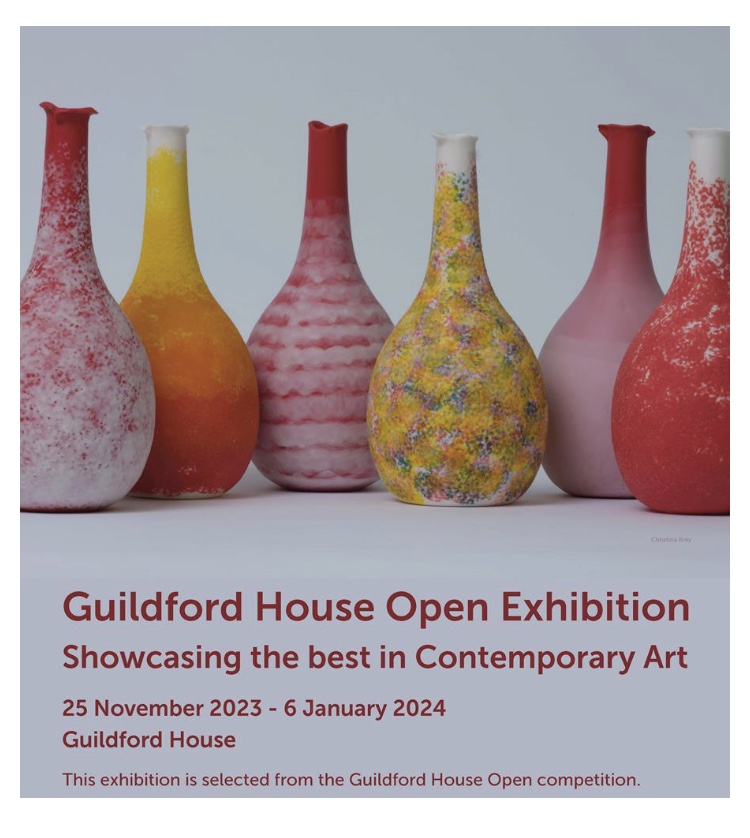
I am very grateful that one of my pieces has been shortlisted between 1,000 entries for the annual Guildford House Open Art Prize.
94 works by 79 artists have been selected by esteemed professionals Tabish Khan, Hayam Elsayed and Will Nash and will be presented in the gorgeous location of the 17th century Grade 1 Listed townhouse, Guildford House. The exhibition presents works across paintings, sculpture, drawing, photography, moving image, textile, print and mixed media.
I am very excited to attend the opening ceremony this Friday the 1st of December.
The exhibition will be open until the 6th of January 2024, so plenty of time for everyone to visit it.
Free to see from Tuesday to Sunday, 10 am – 4,30 pm.
Guildford House Gallery, 155 High Street, Guildford, GU1 3AJ.
Empty – November 2023

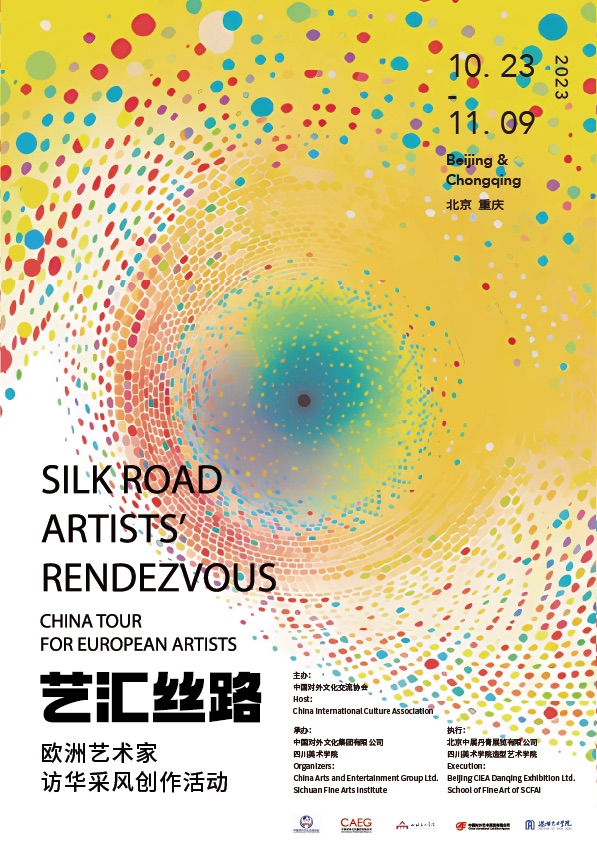
I created this body of work during the art residence ‘Silk Road Artists Rendezvous – China Tour for European Artists’ that I attended from the 23rd of October to the 9th of November 2023 between Beijing and Chongqing.
I often refer to my practice as made of ‘fragments’ and even in this occasion it was natural for me to work on a series, creating a dialogue between multiple pieces.
This work is about the void, the invisible space that surrounds us and shapes the way we live, think and experience life. Emptiness is an existential condition that we all face; focusing on the negative space is for me a way to investigate the nature of this universal state.
I did set the intention for this residence to allow me to see things from a different perspective and I am happy that I had the opportunity to work closely with a professor from the Sichuan Institute of Fine Arts, Professor Wong, for the creation of the final project. Empty is the result of many conversations about Chinese philosophy and a strong artistic connection that combined with my ongoing work on spaces developed into something new. Moreover, I am so grateful that I had the opportunity to learn and practice the ancient art of calligraphy with Professor Wong, and creating a piece together that is very symbolic of all the ideas discussed and on a more personal level, marks a pivotal turning point in my practice.
Empty (in collaboration with Peyong Wong)
Ink on rice paper
69 cm x 137 cm
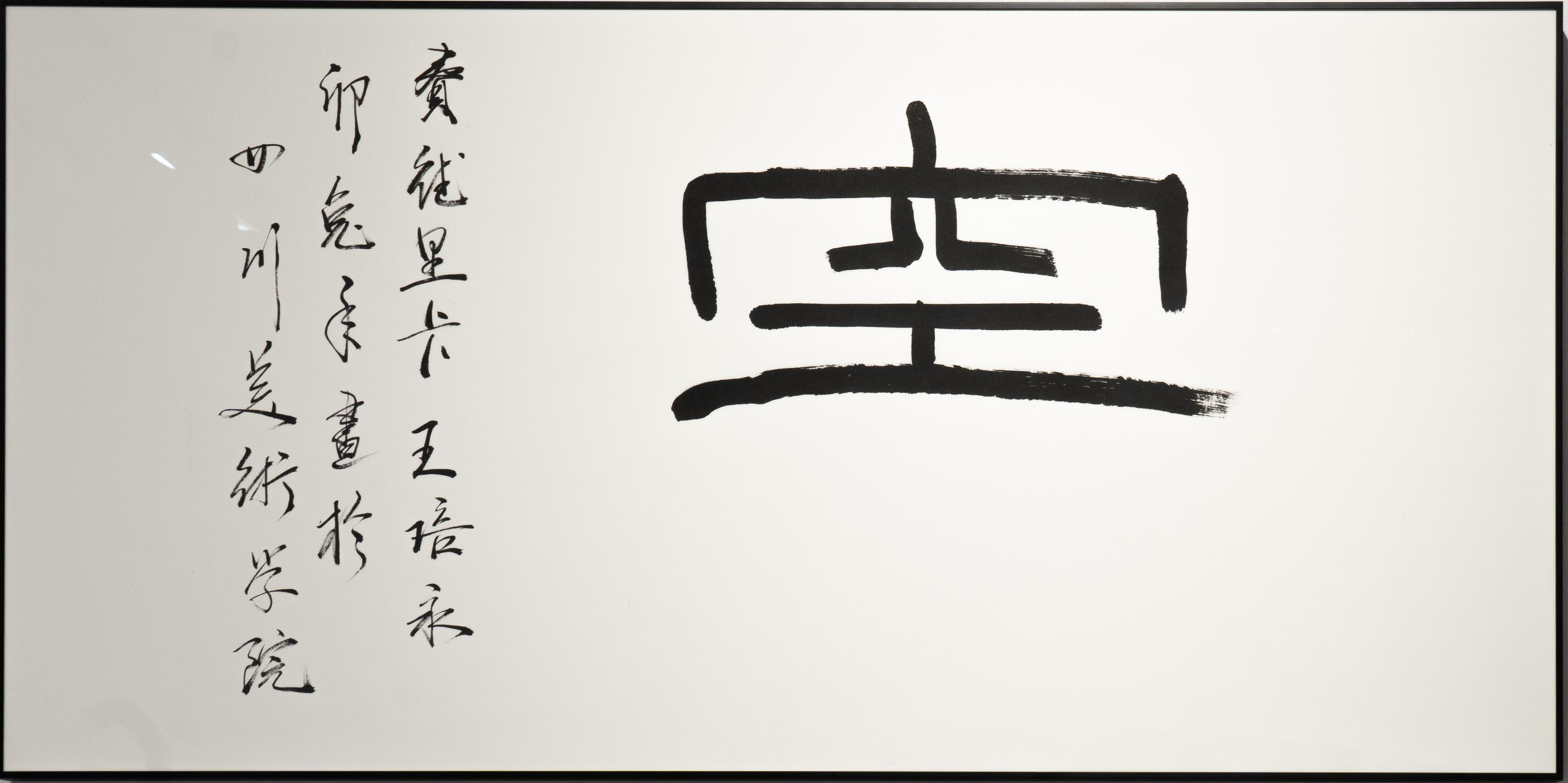
I created this piece after many attempts, under the guidance of Professor Wong, who generously shared his knowledge and studio space with me. I chose to write the character that refers to the word ‘empty’, to deeply explore my ideas on the void in the physical space. However, this word does not not only refer to the emptiness of space, but on a more philosophical level, also to the emptiness and nothingness of our entire human state. Professor Wong completed the work inserting the text on the left.
Great form has not shape
Pen and acrylic on canvas
50 cm x 50 cm (x 3)
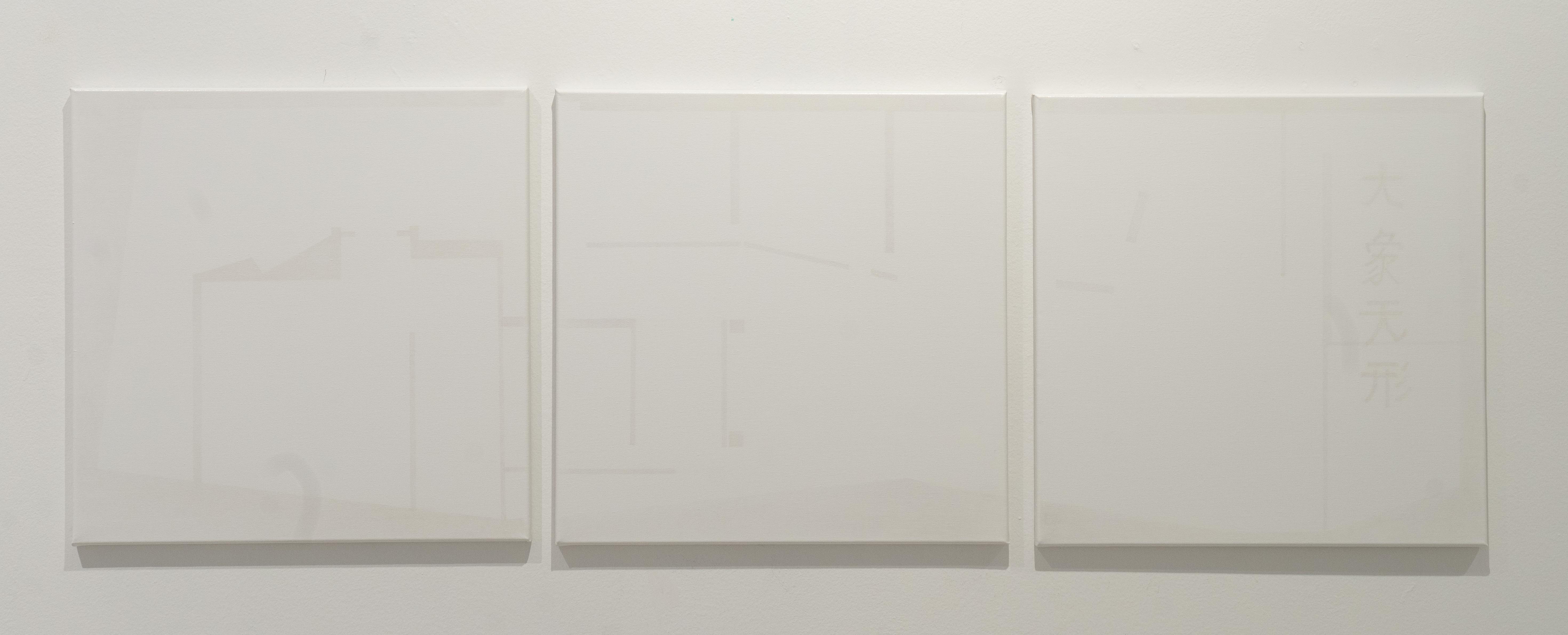
For this piece I decided to work on the floor plan of the exhibition space where we displayed our final works for the ‘Symbiotic Perspectives’ show. Here, painting is used as an instrument to erase and hide, rather than create and add. A patient process of overlapping allows the negative space to gently emerge on the canvas’ surface. The only color used is white, where plain layers cover the pen drawing below and creates a further structure where the work evolves.
The title is the English translation for the Chinese characters ‘‘Elephant Invisible’ that I did insert on the right side of the composition. After long talking with Professor Wong, he suggested the use of this concept that refers to the idea that all things have no shape and they are relatively fine. The ‘elephant invisible’ is both intentional and unintentional and suggests not to overdo, but being compatible with all forms instead. I thought this idea perfectly matched the context for many reasons; first of all, we had only a few days for the creation of all the artworks for the final exhibition and I could not work on big scale, because I am aware that my technique takes long time and I am very slow. So, rather than risking leaving the work unfinished I adapted to the situation instead. Moreover, deciding to work on the negative space of the exhibition space, was a way for me to refer to the works of all the other artists involved, who worked for the same purpose and in the same physical space as me, for the creation of something different. The empty space is here seen not as a lack, but as a space of possibilities and ideas.
Thinking
Pen and acrylic on canvas
50 cm x 50 cm

In this piece I used the same approach as in the previous, overlapping of white layers to create an invisible composition. Here, I decided to work on the floor plan of professor Wong’s studio space (where I was also worked) to reflect on the impact of the available space for creation on the production of the final result. Also, working on the artist’s studio space refers to the artist’s role in society and the responsibility for his/her own creation. Professor Wong suggested the Chinese character of the word ‘thinking’ that I applied at the bottom left of the composition, to indicate a state of progress. Although this may not have a result, it shows that as individual artists, we all have a role of thinkers in society, and as such it marks our social identity.
Sketches #1,#2,#3
Pen on tracing paper
21 cm x 29 cm

Using my main technique which is pen on paper, I did create some preparatory drawings for the above works on canvas, creating a sort of ‘negatives’ (as in the photographic process) drawing the layout of both the exhibition space and Professor Wong’s studio space on tracing paper. The transparency of this medium allows the drawings to delicately emerge into the surface as a sort of x-rays of the voids.
My pieces aim to suggest rather than impose. They present themselves as incomplete, open to possibilities and endless evolution.
Everything goes well
Pure Land Pearl
Zhou Pie Shop
Everyone is responsible for safe production
Pen on paper
14.8 cm x 21 cm
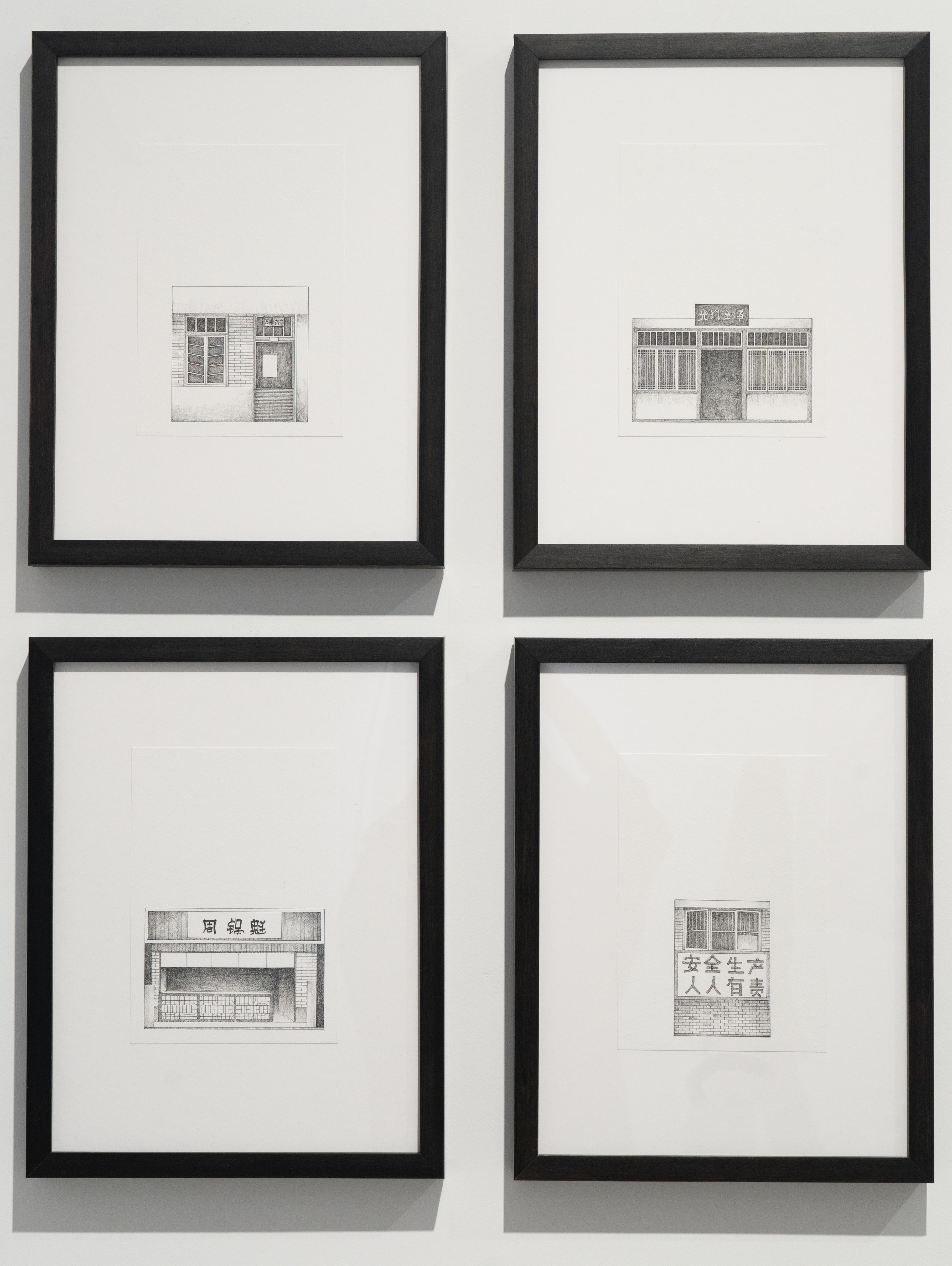
My practice is about the creation of structures, whether physical and psychological, and is connected with the idea of dwelling. Architecture is addressed as a powerful tool that has implications on both people and places. I truly believe that buildings and people constantly shape each other and I am very keen to investigate this relationship with my practice. I draw buildings from all over the world because they tell stories of the inhabitants; working with structures is a way for me to explore both physical and emotional landscapes.
This series of drawings aims to highlight four main architectural ways/areas of shaping places and people’s lifestyles that I spotted during the time spent travelling across China with the ‘Silk Road’ group. From top left to bottom right: the house, the temple, the shop and the factory. The details of each facade are explored in their geometry and the translation of the Chinese characters included in the compositions not only provide the title for each work, but also suggest clues for a deeper understanding of the Chinese society and its inhabitants.
Symbolic Perspectives,
8-14 November 2023
Sichuan Institute of Fine Arts, Chongqing
Curated by Wei Jia and He Guyian.
Hosted by China International Association and organised by China Arts and Entertainment Group Ltd.
SILK ROAD ARTISTS’ RENDEZVOUS / China tour for European artists – November 2023
I am so grateful to have been selected to attend this art residence between Beijing and Chongqing, representing Italy alongside other 8 incredible artists from different European countries.
I have been able to explore beautiful places in China, meet amazing people and collaborate with Professor Peyong Wong at the creation of the works for the final exhibition ‘Symbiotic Perspectives’, that will be open at the Sichuan Institute of Fine Arts in Chongqing until the 16th of November. Curated by Wei Jia and He Guyian.
Hosted by China Arts and Entertainment Group Ltd. and Sichuan Institute of Fine Arts, with the support of the Chinese Minister of Culture.
Unrolling my Process – September 2022
‘As the spirit of doorways and arches, Janus is the perfect model for transitions. When passing through a door, one is simultaneously leaving and entering.
Embracing the new does not mean discarding the old wholesale.
Each day we make choices. We are confronted with many small doors every day, and we have the opportunity to decide whether to pass through them. Many days, we choose the familiar and routine. Some days we may choose the default because we failed to see options or because we are exhausted by the pace of change. If we are to make progress, we must pass through those doors and learn about this new world.
We don’t have to have everything figured out and planned before we start. The essence of strategic thinking is about direction, not about steps. We have a vision of where to go, and we figure out the path as we go along. Many may feel paralyzed because they don’t know what to do. The key is: We cannot let the perfect be the enemy of the possible. Ask yourself, What can I do today? No matter how small, do something.
Ultimately, to thrive in this world, to realize the best-case scenario, we need the spirit and attitudes of pioneers. We need the courage and—maybe more important—the desire to step outside our comfort zones. We need the willingness to leave what is comfortable and familiar and to pass through the doorway to the unknown.’*
I came across these passages when reading an article about archival digital preservation, but
I could not help finding these points very illuminating not only in relation to my artistic practice (as the description of the doors really made sense to me and made me understand why I did so many doors drawings in the last couple of years), but also in relation to the concept of process. In art as in life we should accept changes, but most of all we should keep trusting our vision, no matter how long it will take to see the results.
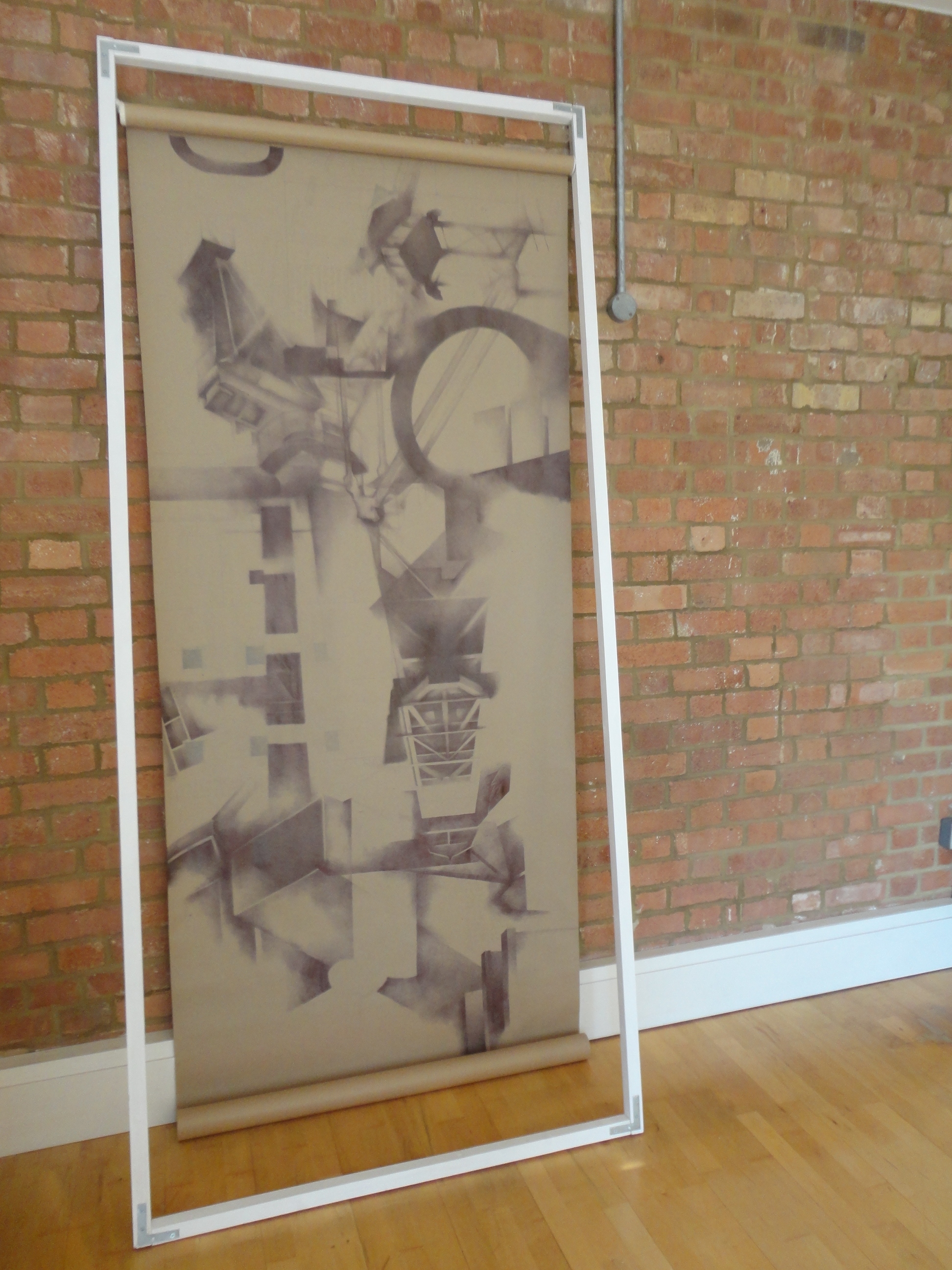
I have started my big work, which by the way is called Process, in 2013 and for me it means exactly all these things. I have started working on it in a moment of drastic change of my life (and my art, but obviously they are very connected) with the idea to keep it as a never ending project. It is funny to see that I go back to working on it always in the moments of major confusion, when I feel lost, disorientated and therefore, seeking a change.
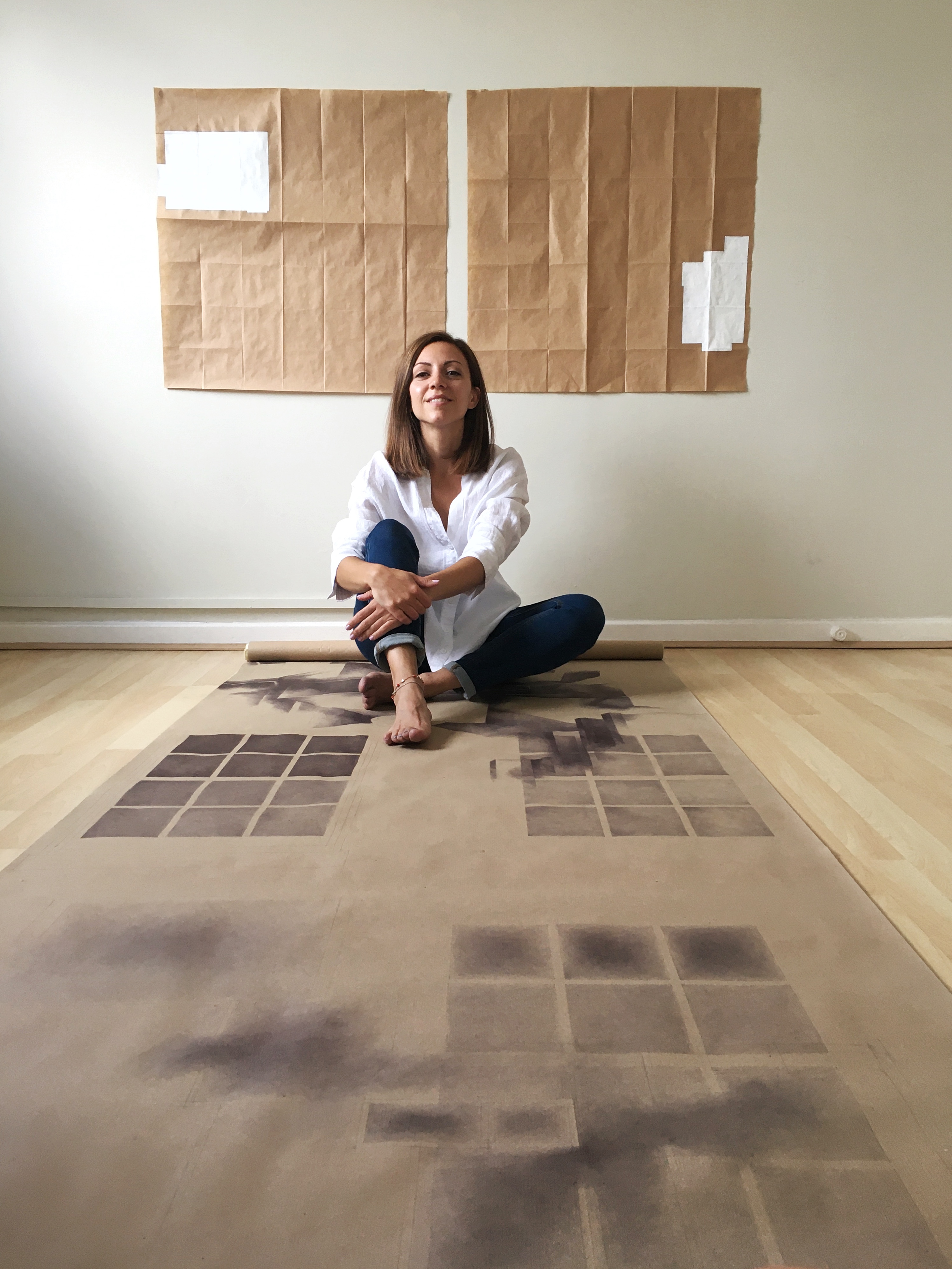
I went back to working on it some months ago and I am happy to show some small progress, unrolling this precious roll little by little, building the future, but never forgetting the past.
*Quote from:
Pearce-Moses, Richard, Janus in Cyberspace: Archives on the Threshold of the Digital Era, The American Archivist, Vol. 70, No.1, 2007.
Finding Gustav Metzger (and myself) in London / The Podcast on the road – with Emily Barsi and Ralf Homann for the Kunstraum, Munich – April 2022
I have been invited by one of the curators of the Kunstraum-Munich, Emily Barsi, to take part in two episodes of the podcast she is working on with her colleague Ralf Homann, to accompany the Gustav Metzger exhibition they are currently holding at the Kunstraum.
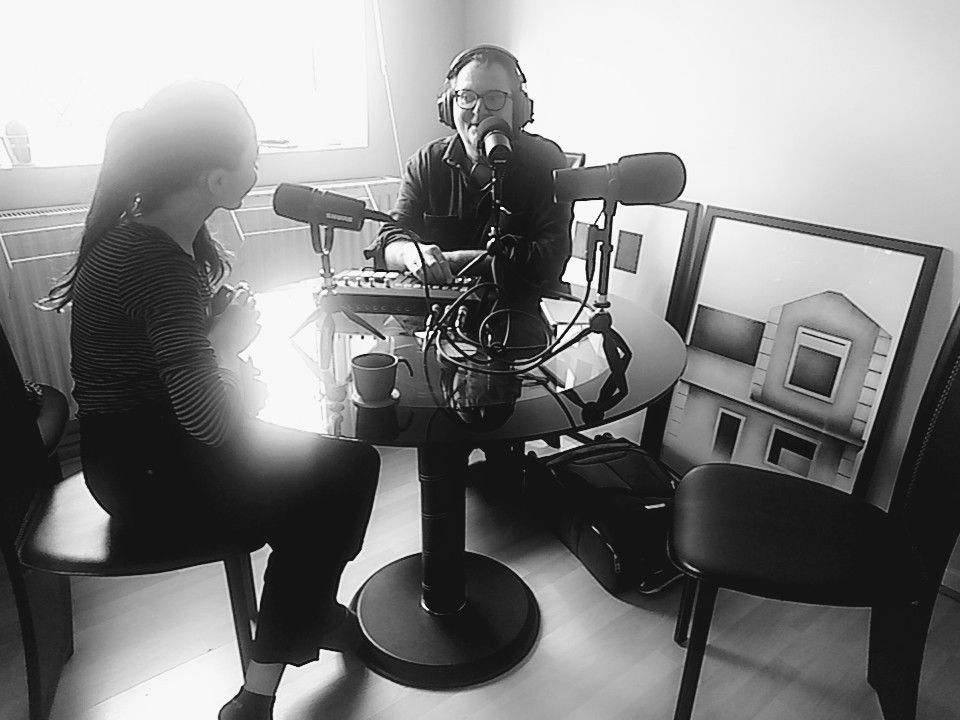
I welcomed Emily and Ralf in my apartment/studio, where I have been asked to talk about my practice, my artistic evolution, my life in London, my job in an archive and of course, I ended up talking about houses and dwelling and the influence that cities and spaces have on artists’ work and on their lifestyles.
My interest in the cities and my connection with places is growing with my work and experiences and thinking out loud about it, pushed my curiosity (and obsession) even further. I do not know how my talking with Emily and Ralf will sound like after the editing, and I am not sure how clear it would be my English attempt to express some completely abstract concepts that I can barely explain in Italian, but… it was so much fun! (and inspirational)
I also had the opportunity to take part in the ‘podcast on the road’ part of the project: a nice day out strolling around the streets of London, following the traces left by Gustav Metzger, during the life he spent here after escaping Germany during World War II. The three of us went all around from Highgate cemetery, where the artist was buried in 2017, to Covent Garden, where old exhibition spaces turned out in posh French tea houses and fancy perfumes shops.
Metzger’s work is rich of political influences, and concepts aimed to address a sense not only of destruction, but loss, disorientation, protest, perhaps also a feeling of ‘not-belonging’ (this is from my personal point of view). It was interesting to address topics such as migration and of course London had a central role in all of this. London is not only a background, but it is always a central character in the life and stories of all its inhabitants.
The third episode of the podcast will be an interesting conversation with Paloma Gormley, English architect working towards sustainable architecture and alternative housing.
The podcast will be release in 3 episodes in October 2022 on the Kunstraum website.
Tate Staff Biennale 2022 – March 2022
I am pleased to have two pieces on display for the 2022 edition of the Tate Staff Biennale, which is a miniature group exhibition by artists who worked and/or currently employed at Tate.
As the theme was Love and Loss, I decided to present one piece from the ‘Doors’ series that I have started at the end of 2020 and is very symbolic of a phase of personal and artistic transition.
I also decided to present a second piece, despite it being only one of a series of 4 sketches that I am still making, in preparation for a new body of work. This is a very intimate project still at its early stage, but I wanted to give it a go to show (to myself first) that it is possible to rise again from ashes and evolve into something different.
Love and loss are human circumstances that can be experienced in multiple ways, inevitably exposing one to a condition of vulnerability and disorientation.
With these two little works I wanted to address both ends and beginnings, opening the road to a range of possibilities in between.

Japanese store-fronts postcards set – November 2021
Christmas is always pushing me towards the production of lots of cards.
I started making my own Christmas cards when I moved to London around eight years ago, mainly because I noticed the great consideration they get in the UK. In Italy, where I am from, there is not the same level of attention for giving and receiving cards during the festivities, so this is something that really impressed me at the beginning of my English life, and it also made me think.
I could not help but be concerned about the big environmental impact of the production (and the subsequent disposal) of these cards; sold in big bunches for little money and distributed on a massive scale every year and for every occasion. So, I began producing my own ones, with the hope to create something more unique, to reach the people who I love the most and using my art as a tool.
I started really enjoying making cards as it allows me to experiment with different subjects and/or techniques every year. It is also a way for me to reflect on my own practice and decide new directions and possibilities; questioning on what has been done, wondering what has still to be said and sometimes opening the road for something new.
In 2021 lots of things happened, new adventures began, many decisions have been made and some happy events have marked a new beginning. Artistically speaking I am still in a phase of a profound change that I do not know where is going to lead me. However, while I am waiting and maturing new ideas, I decided that this Christmas was the right moment to celebrate the transition and the unknown rather than forcing the production of something new.
Therefore, I made a mini-series of Japanese-storefronts. The first Japanese-storefront was made at the beginning of the year in a very personal difficult moment. It came out so extraordinarily randomly, it has been shortlisted for a drawing Prize open internationally and it is currently on display in one of the major exhibitions of drawings in London. Japanese store-front #1 is a lucky charm for me and I wanted to pause and reflect on this unexpected work as a way for me to take time and consider the potentiality of taking alternative routes, in art as in life.
I created a small series of five pieces inspired by the photos taken by @storefronts.japan in Tokyo. For the first time I decided to print them in a limited edition of 20 copies each and make them available for sale. This is so exciting for many reasons; first of all I am very happy with the result, but also, this is giving me the possibility to remark on two points that are very important to me.
The first is, from a person who really cares about the impact that every single action has on our planet and on other individuals, to remember that we all have to take responsibility: deciding what to make, what to buy, what to eat, what to dispose of and how, is all in our power. Deciding to buy cards and Christmas gifts from artists, designers and makers for instance, is a strong way to take a position and to consciously stand for a more sustainable life-style.
Also, supporting the artists is necessary. Art is the engine that drives this mad world: it is a way to escape from the ordinary, the chance to see the beauty in the imperfection and the only moment that we have to stop in doing whatever we are doing and simply contemplate and think. Buying from an artist is supporting all of this, is allowing an individual to make the hardest of the job, involving a total engagement with all aspects of life and making possible for everybody to dream about the invisible and incomprehensible force that makes us human.
My postcards are on sale in sets of 5 for £10 or in sets of 10 for £20.
Please, do not compare these prices with cards industrially produced and sold by big companies in bigger quantities for less money, because it is not the same thing. Remember that when you buy from artists, designers and makers of all sorts, you are not paying only for the products, but you are supporting the (long, difficult, time-consuming and sometimes painful) process of creating and you are getting in exchange unique pieces that will speak for their creators forever.
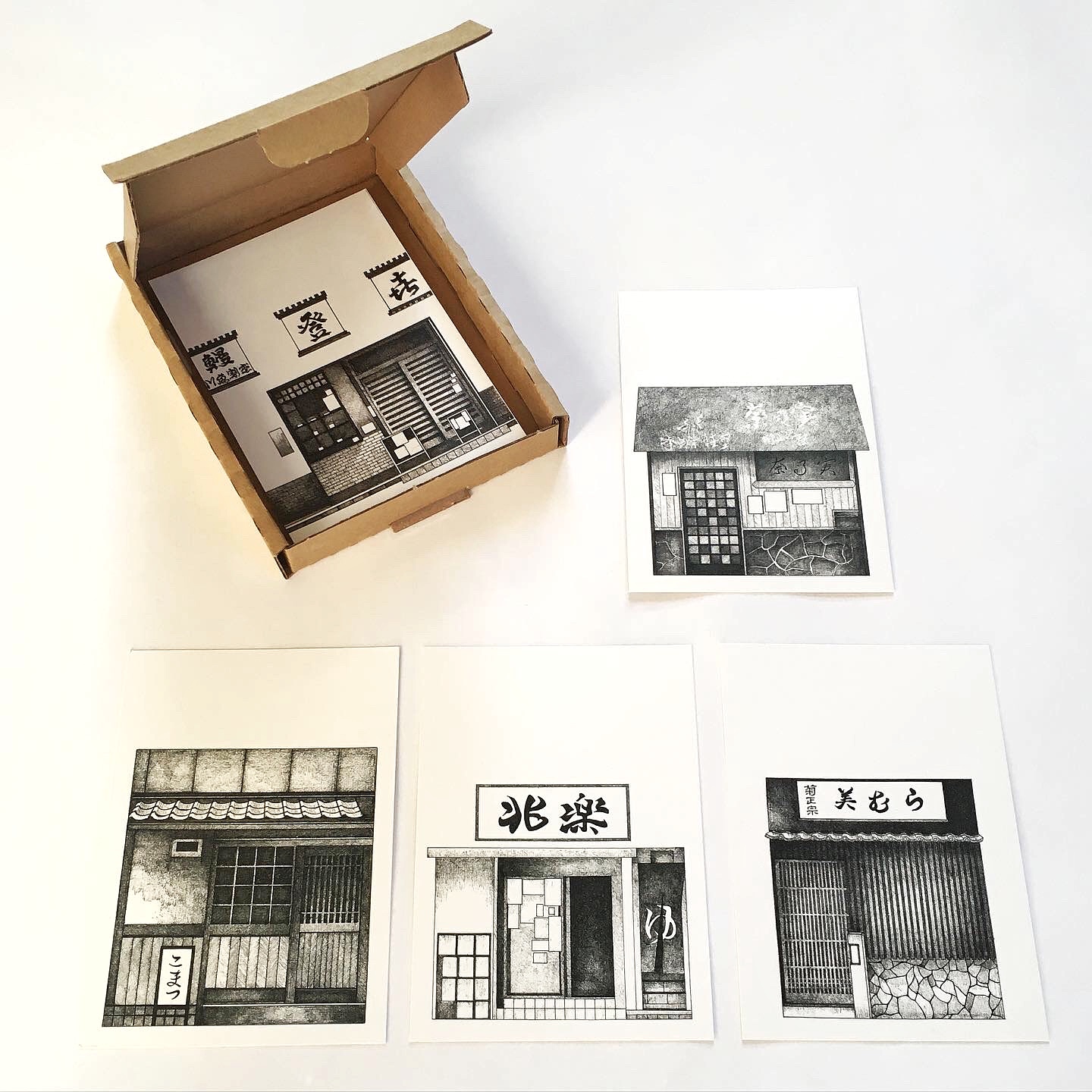
Japanese store-fronts sets. Original drawings printed on paper/postcards size, 2021.
Trinity Buoy Wharf 2021 – November 2021
The Trinity Buoy Wharf exhibition is about to open!
All the beautiful drawings shortlisted for the Drawing Prize 2021 are on display, including my beloved Japanese store-front #1.
The exhibition will be open from 18 November to 6 December 2021
Every day from 11 am to 4 pm
At Trinity Buoy Wharf, 64 Orchad Pl, London E14 0JW (nearest tube station: Canning Town)
The exhibition will then be presented at Drawing Projects UK in Wiltshire from 8 January to 5 March 2022.
More info here: http://trinitybuoywharfdrawingprize.drawingprojects.uk/news

Japanese store-front #1 – September 2021
I am very pleased to announce that one of my recent drawings, Japanese store-front #1, has been selected to take part in one of the most important annual exhibitions of drawings in the UK: Trinity Buoy Wharf Drawing Prize 2021.
‘The Trinity Buoy Wharf Drawing Prize 2021 exhibition will include 101 drawings by 89 artists selected by Sheela Gowda, Artist, Simon Groom, Director of Modern and Contemporary Art at National Galleries Scotland, and Zoé Whitley, Director of Chisenhale Gallery in London, and 13 drawings by 12 drawing practitioners selected for the Working Drawing Award and display by Leonie Bell, Director of V&A Dundee, Charles O. Job, Designer and Architect, and Paul Finch, Programme Director of the World Architecture Festival.’
More info here: http://trinitybuoywharfdrawingprize.drawingprojects.uk/news
I am honored that my work has been chosen to take part in this big event.
This is a great opportunity to reflect on the development of the drawing practice in the contemporary art scenario and see one of my pieces alogside other artists’ works.
I will never get tired of remarking on the necessity and the cultural impact of art in society, but this time I would also like to mention the creative urge and the constant struggle that I share with all artists, that lie behind every work.
This is to remind us how, when this vital need of expression can sometimes turn into something rewarding, many other times it can remain unseen. Yet, it is essential for the development of free thinking in every democratic society.
We should not forget that for one artist selected there are millions still working in the dark, uncelebrated, underpaid, having to do many job(s) in order to keep on making art and actively contributing to the cultural collective growth.
I am grateful for having the opportunity, this time, to show what I do.
Art for me is struggle, joy, responsibility, power, burden, relief, pain, risk and salvation.
Japanese Store-front #1 has been made in one of the toughest moments of my life, when I could not see the purpose of anything and drawing became not only a necessity, but the only thing I could do to survive a deep sense of powerlessness. The style, technique and subject are different from what I used to do and this makes me even more excited to show it to the world as a reminder for myself and everyone, that when you are broken in half, something powerful can get out and take unexpected shapes.
I will post some more info on exhibition venue and times very soon.

Pen on paper, 14,8 cm x 21 cm, 2021
https://www.trinitybuoywharf.com/news/trinity-buoy-wharf-drawing-prize-2021-shortlist-announced
Doors and facades – April 2021
Ending
This has been a weird year. Intense, slow, apparently uneventful, but yet filled with unexpected implications and therefore, conflicting emotions.
I do really hope to be directed toward the end of this tumultuous, extremely long, existential and almost cathartic path that I experienced without even leaving my London apartment.
It was definitely the year of the big finish: of important journeys and artistic projects.
Everything magically came to a conclusion at the same time.
Waiting
I cannot say that this has been a very productive time (I guess I share this frustrating feeling of being placed on hold for too long with the majority of people). However, I have made choices that I would not have made otherwise. I deeply explored my inner self and I managed to admit and say out loud what I really want from life. I confronted my vulnerability and I accepted it. I faced my biggest fears, and I fought them by mastering the arts of patience and resilience. I learned to meditate and to use the mind to turn unfavorable situations into interesting opportunities.
I realized the value of the present, because I understood that is the only thing that really exists.
I felt alone more than ever, but I decided to believe that I had been given the opportunity to create something new and I am determined to do so, even if this implies a considerable amount of pain, because it means to let the past go.
I have absolutely no clue of how the future will look like and I am very scared even at the idea of leaving my flat and jumping into the real world again at the moment. I do not have any plans, or projects, or confirmations that things are going to be fine. But, I do appreciate that every time that one’s previous balance collapses, it is important to wait and clean before building on rubble.
Changing
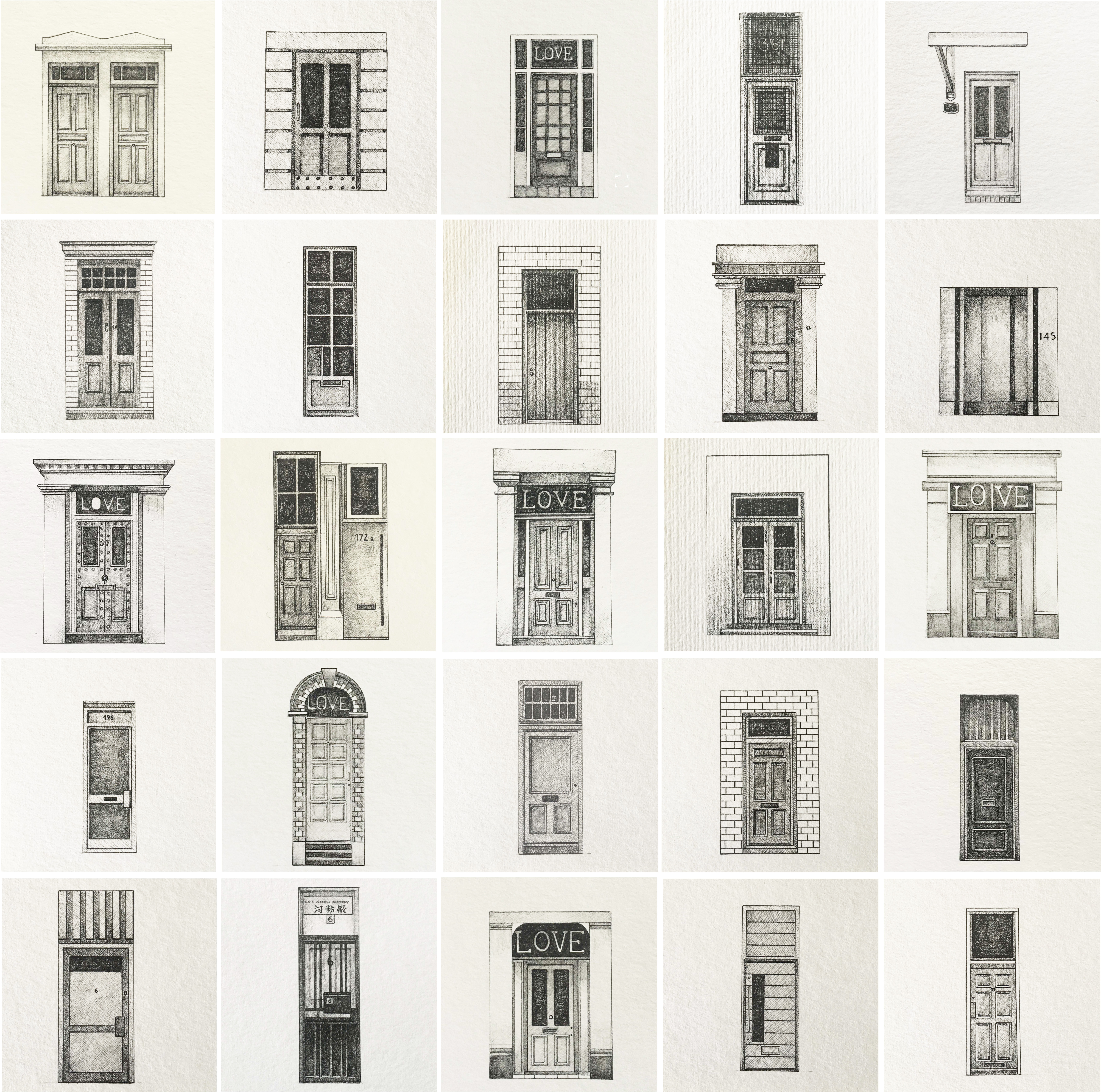
Over this endless waiting time I have been working on a new idea. I became a house (and door) portrait painter. This happened accidentally and with no expectations whatsoever, but I am so grateful that it did, because not only did it help me to survive the longest and darkest time of my life, but it also gave me the strength and the motivation to open up to something different and new, that I would not have probably considered otherwise.
Doors and Facades are incomplete shells standing in their silent entirety.

Architecture is of course the main element that links this new production with my previous work, but here it has been treated differently.
The attention is placed on the full buildings rather than on details, as envelopes that stand for their inhabitants and in a constant relationship with their reciprocal needs. These buildings are not anonymous structures as in my previous works, but recognizable inhabited spaces.
Using the same technique, pen on paper (although a different type of pen), here I play with light and shadows, emptiness and fullness, actively using the negative space and focusing on the main elements that define the buildings’ identities.
The drawings are never totally completed, as usual in my practice, but the result is definitely more realistic than before.
The human body is always present, but never visible. It lies in the proportions and behind the external layer of the houses.
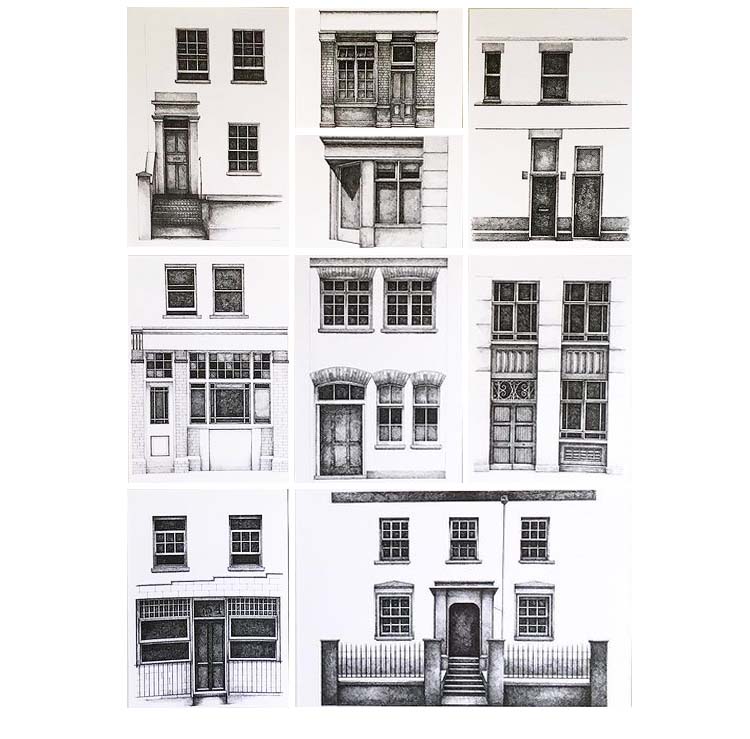

In a complicated historical moment, when the relationship with the structure we are locked in is stronger than ever, the container and the contained are becoming the same thing: we are the space we inhabit even more than before. Portraying London with Doors and Facades has been my way to work on this connection and to establish a link with the space outside, exploring artistic possibilities and telling stories of solitude and community of living in the city.
Art has been a companion and a powerful tool of expression, a way for me to elaborate suffering, anxiety and loss and to try to make sense of the extreme situation of isolation and change that has affected us all, physically and mentally.
My practice is very much about fragments. Sometimes it is difficult to make sense of them if we have not watched them all together, one next to the other. Still, every single piece is fundamental and essential in the construction and in relation with the previous and the following one.
As everything in life, it is a matter of perspective and points of views.
I am currently in the process of making new pieces without a definite idea on where this will bring my work, but I believe that there will come the time when every fragment will go into an order and the bigger picture will suddenly appear clearer and more understandable.
Time to rebuild – July 2020
Over these challenging months it occurred to me that this difficult time can be looked at from a different perspective.
I am devastated that every piece of the life I’ve built over the past few years, with so much effort, is being destroyed.
All of a sudden I don’t have any control over it.
I am sure millions of people, for different reasons, feel exactly the same way.
We have been forced to face the downsides hidden in our daily routines and the safety of our habits. Forced to slow down and meticulously question and analyse every detail of our lives, jobs, and relationships. This has made room to rethink our priorities.
I dedicated most of this new free-time to my artistic practice.
I view my relationship with art as exclusive and pure; unrelated to money. And as such I have always suffered with not finding enough time to dedicate to it. Still, after almost ten years of my adult artistic life -which unfortunately hasn’t become my main profession- I cannot help but think of creating as my only way not to simply exist.
One of the things that working with art teaches me every day is patience, as being hasty will not bring any long-term results. The time of art flows differently from the time of life. I am still learning how to adapt to that and how to combine the two of them daily. Mistakes are not only important, but they are in fact a key part of the process of making; failure is not a waste of time but a necessary stage to face, though difficult to accept.
I can’t help but notice how these considerations are important when applied to everyday dynamics addressing these current uncertain and frustrating times, how it is fundamental to be open and reconsider what we used to take for granted; accepting failure and the unexpected as part of the process of living.
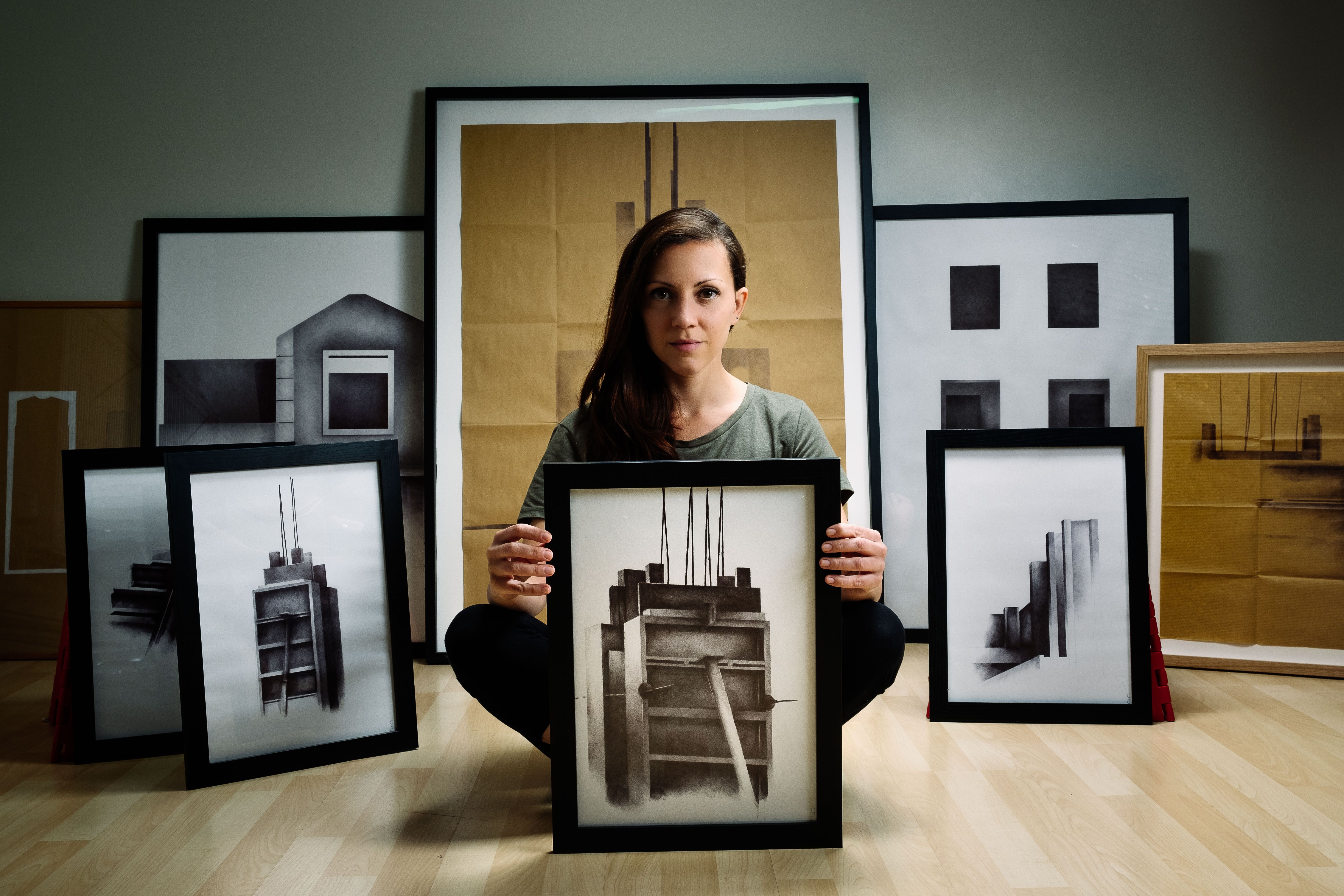
I had the idea to take this photo for fun, but also because I recently realised that my struggle with art/job time over the last few years has not been in vain. I have managed to produce a decent amount of drawing material that is stored in my apartment, and the part of it that is framed gave me the inspiration for this setting, as a celebration of an honest and constant commitment.
With the time dilatation I have had the opportunity to relook at my work, reorganise it and give it a proper structure. I also made some small changes here on my blog in order to clearly present my art practice and make it more understandable.
For this reason I have updated the PORTFOLIO page so that it now shows the collection of all my works made from 2010 to present. This is not in chronological order, but I have left the images relevant to my artistic evolution as fragments that together give a bigger picture of me through ten years of work on different media.
The SHOP page is a brand new addition and lists all the pieces available for sale with a much clearer indication as to the date, material and size.
The CONTACTS page has been updated and it is very easy to get in touch with me via email and/or social media so please do not hesitate to do so if you are interested in my work.
It’s not all only about construction, but about RECONSTRUCTION too.
House – June 2020
Endless and interrupted visions,
left pending.
They are in constant evolution, but stationary.
Empty shells and open spaces
stand as worn out skeletons.
The houses I want to talk about do not have life,
but they occupy a physical space and they share it with us.
They tell of bodies not longer here or that have never been.
The body is always the main character, with his absence.
Houses in construction or that have never been finished,
abandoned houses,
on hold and in decay.
Structures and ideas,
construction and decadence,
perishing and becoming.
They are solid and abstract geometries
drawn by the human beings around their own bodies
and hand over to the time.
Federica Beretta, 2020

Visioni infinite, interrotte,
lasciate in sospeso.
In perenne divenire, ma ferme.
Involucri vuoti e spazi aperti,
scheletri disfatti dal tempo.
Le case che voglio raccontare
sono prive di vita, ma occupano uno spazio fisico
e lo condividono con noi.
Parlano di corpi che non ci sono più
o non ci sono mai stati.
Il corpo e’ sempre il protagonista, con la sua assenza
Case in costruzione, case mai finite di essere costruite,
case abbandonate,
case in attesa e in disfacimento.
Strutture e idee,
costruzione e decadenza.
Decadimento e divenire.
Solide e astratte geometrie
disegnate dall’uomo, intorno al corpo dell’uomo
e consegnate al tempo.
Federica Beretta, 2020
London postcards – May 2020
London postcards is a new body of work: a series of 10 drawings, pen on white paper and tracing paper overlapped, measuring 30 cm for 42 cm each.


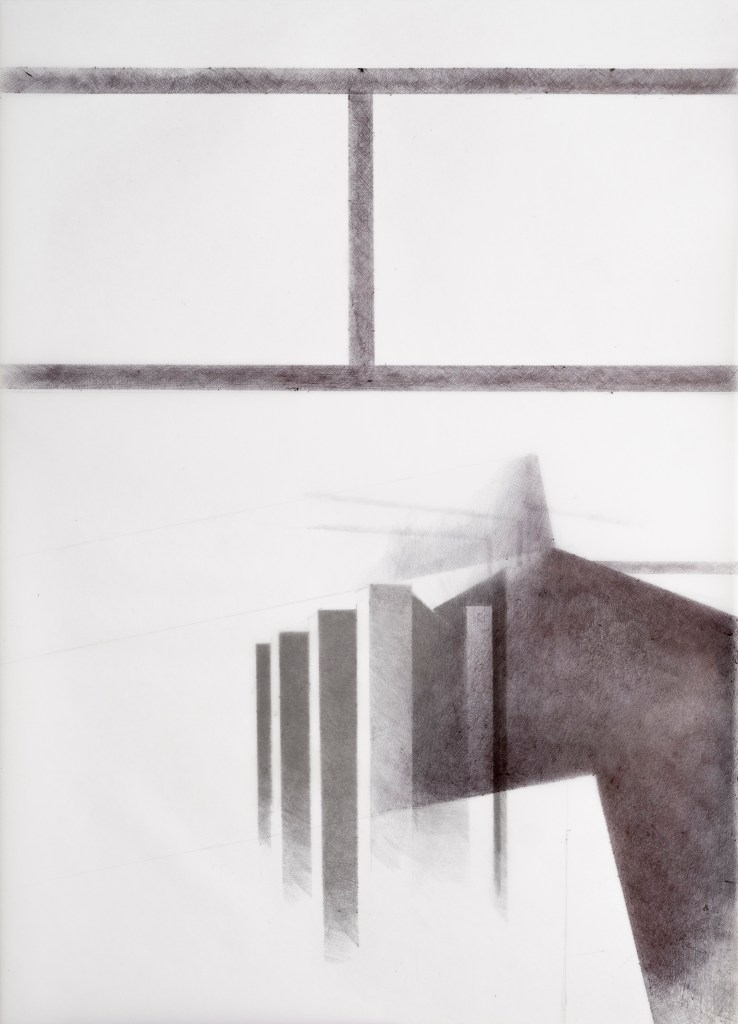
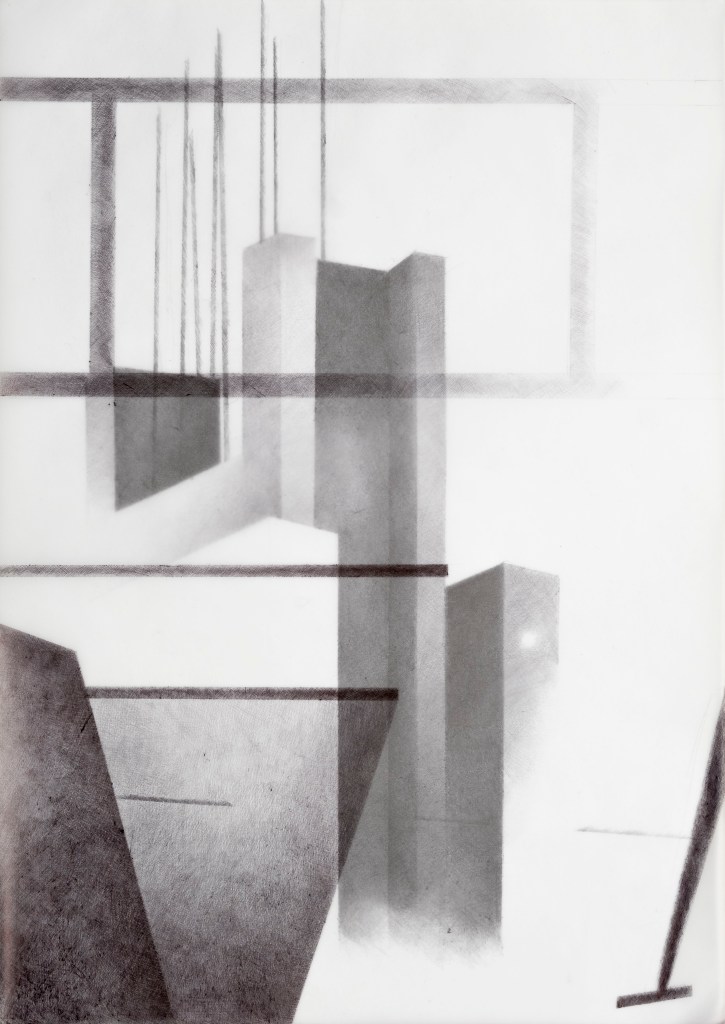
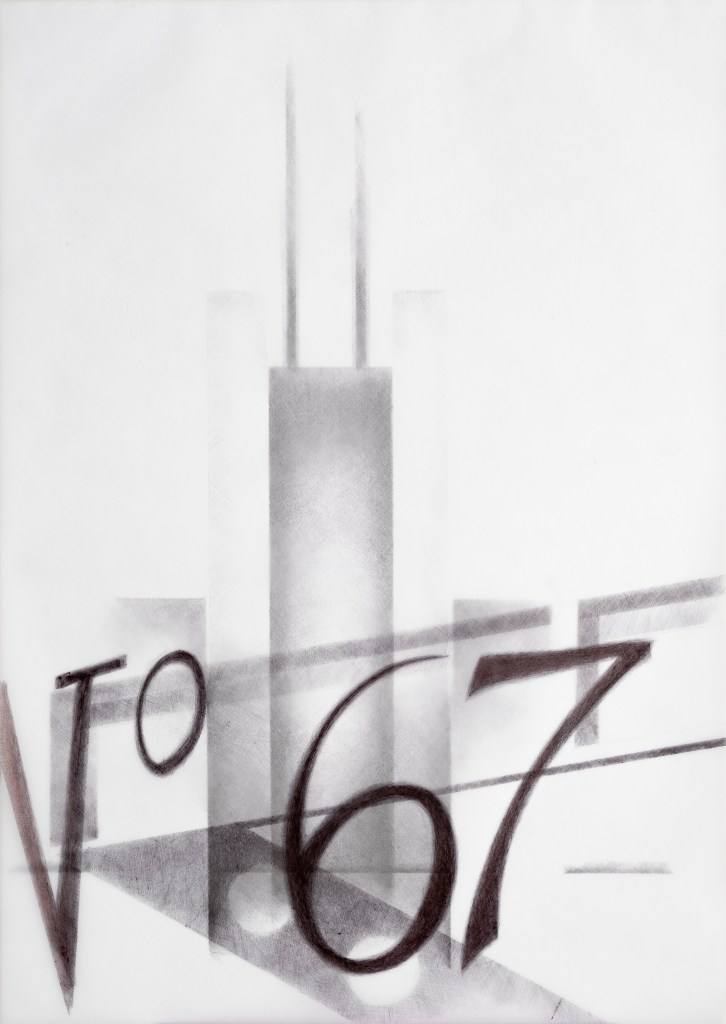
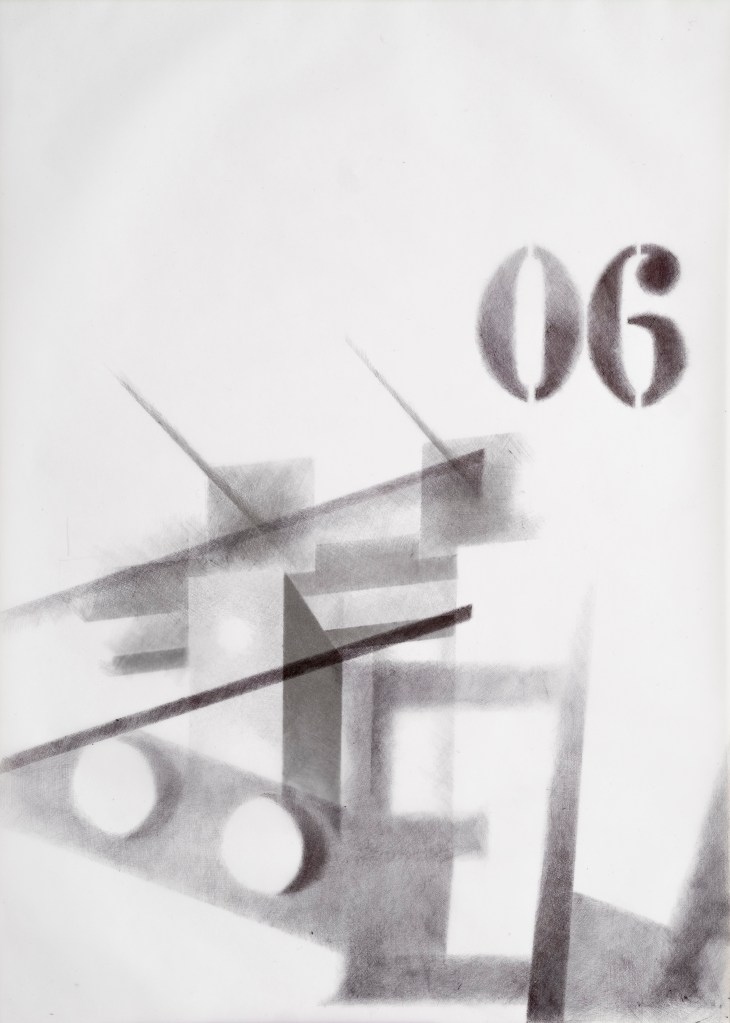
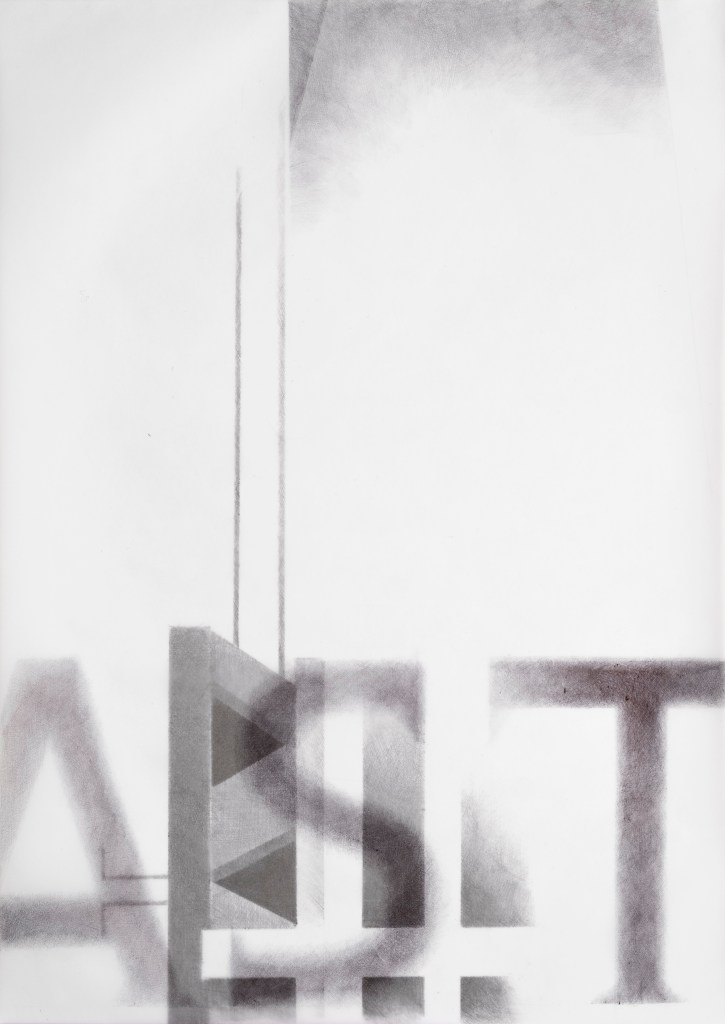

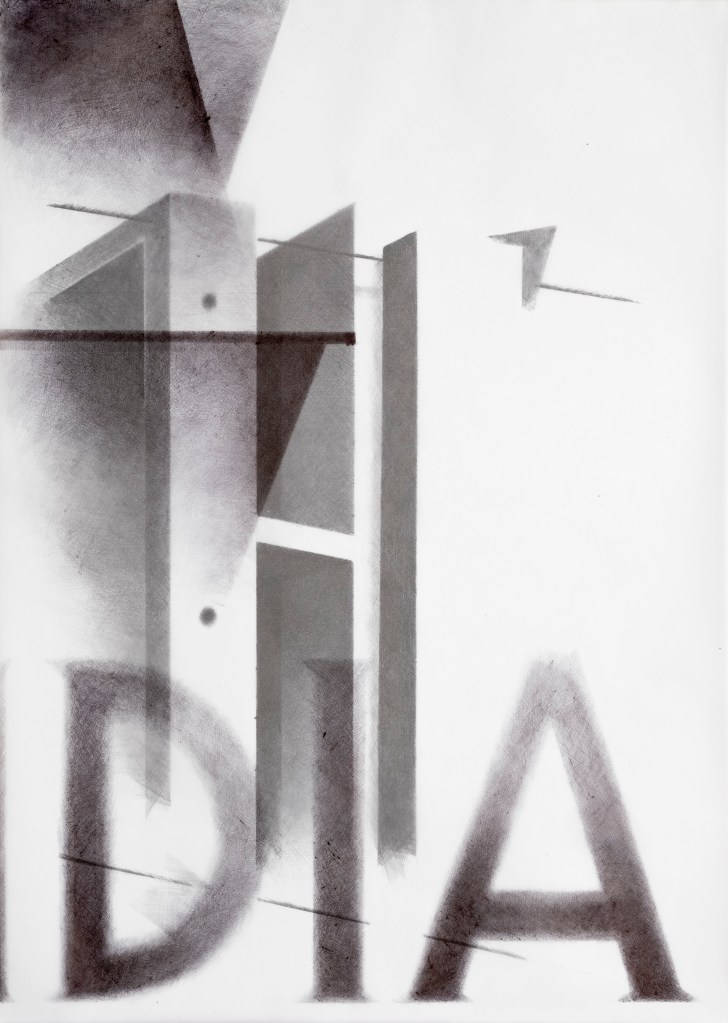
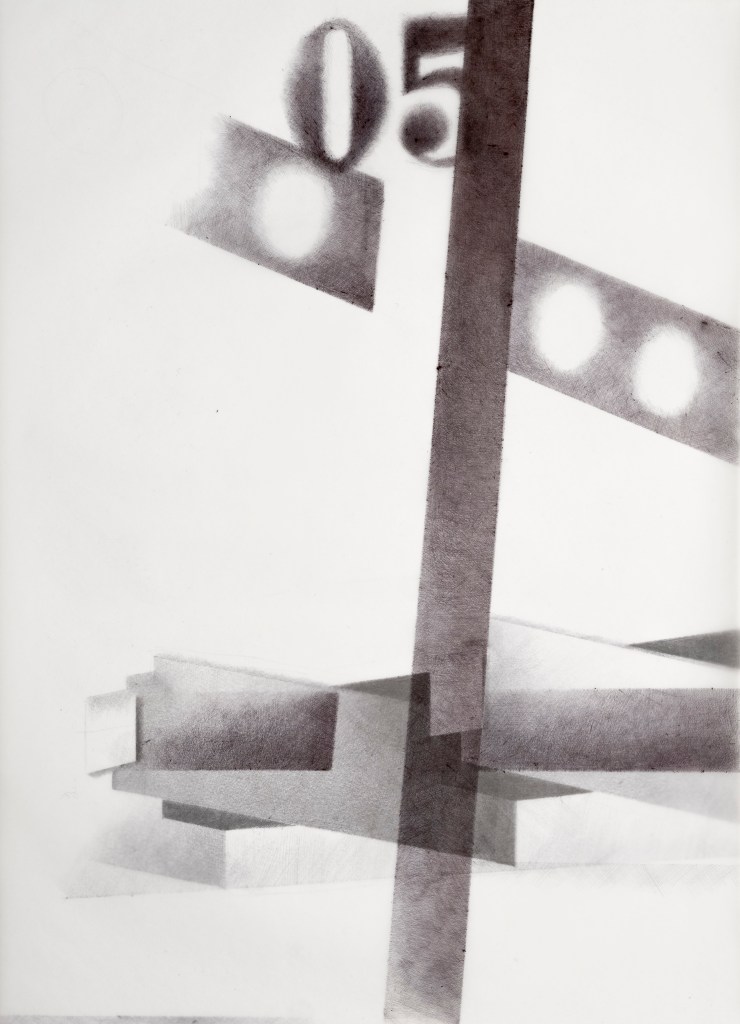
This time I worked on layers, playing with two different typologies of paper combined and with the overlapping as an alternative way to build the drawing.
I used the tracing paper for the second layer which is a support originally used in Architecture practices and in general not ideal for fine arts drawings. It was in fact very challenging to draw on it, especially with my biro pen, but it gave me the possibility to create a more articulate composition in terms of expanding the structure and the range of tones from the black and white scale, playing with shadows and contrasts.
What is interesting here is the potential of creating multiple compositions changing the second layer as a mask. I think this is another way to never give the drawing the status of finished.
The subjects of the second layers are details of old London buildings, what I like to call survivors. London is a very dynamic city and is constantly growing. So many construction sites are part of the Londoners’ landscape from the city center to the suburbs areas and they share the same space with some old, small Victorian brick buildings, most of the time with pubs on the ground floor decorated with lovely shop’s signs. They seem not to intend to surrender and leave their space to any big developers. As the physical space is so limited and so important in big cities, I like to think of them as survivors.
I have started working on the survivors making postcards some years ago just for fun (on postcard size paper), but I’ve never considered using them for an art project. At the same time I was looking for a way to involve the overlapping in my work and I started experimenting with some random sketches on tracing paper since 2014. The project progressively took a more structured shape within the years when I finally decided to combine these two parallel interests in one (on a larger scale) and this is what it came from it.
I like the idea of London Postcards as a title because this is my personal way to represent the city that welcomed me almost seven years ago and where I grew as a person and as an artist.
Cities are like homes and they are able to forge and shape their inhabitants in the same dynamic as we are able to shape them back: the relationship actively involves both parts.
The art practice and the artist’s vision feeds from this indissoluble bond.
#inhabit
Eight Pillars – May 2020
Eight pillars is a series of 8 drawings that I have started in 2017 and completed in 2018.

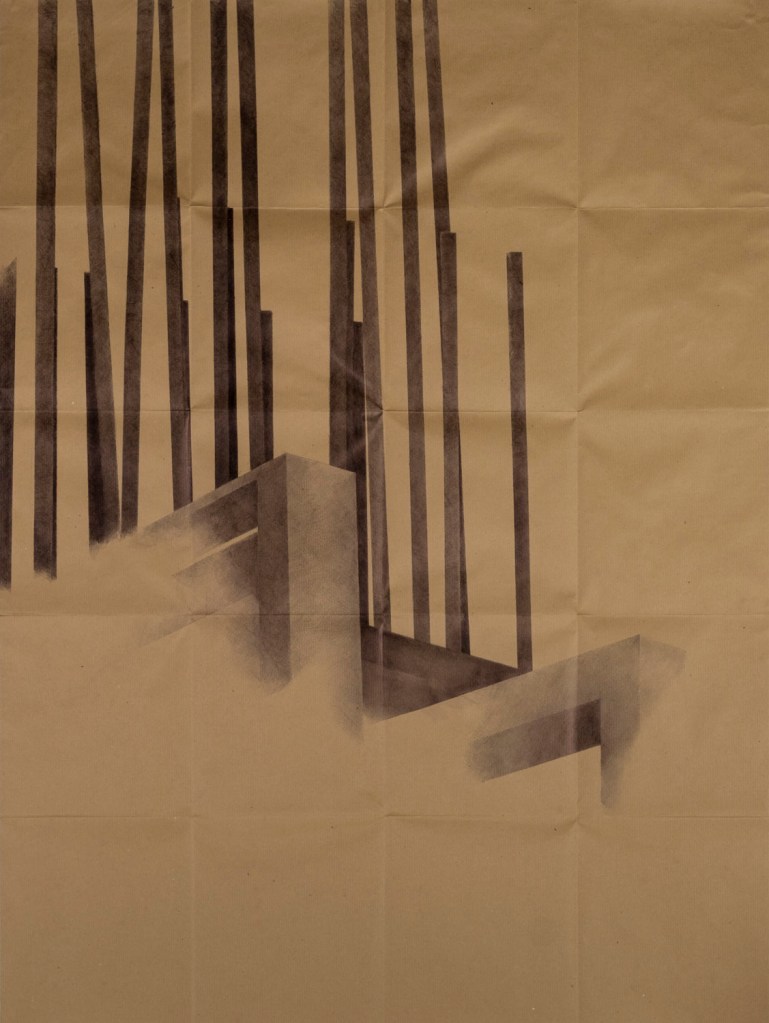


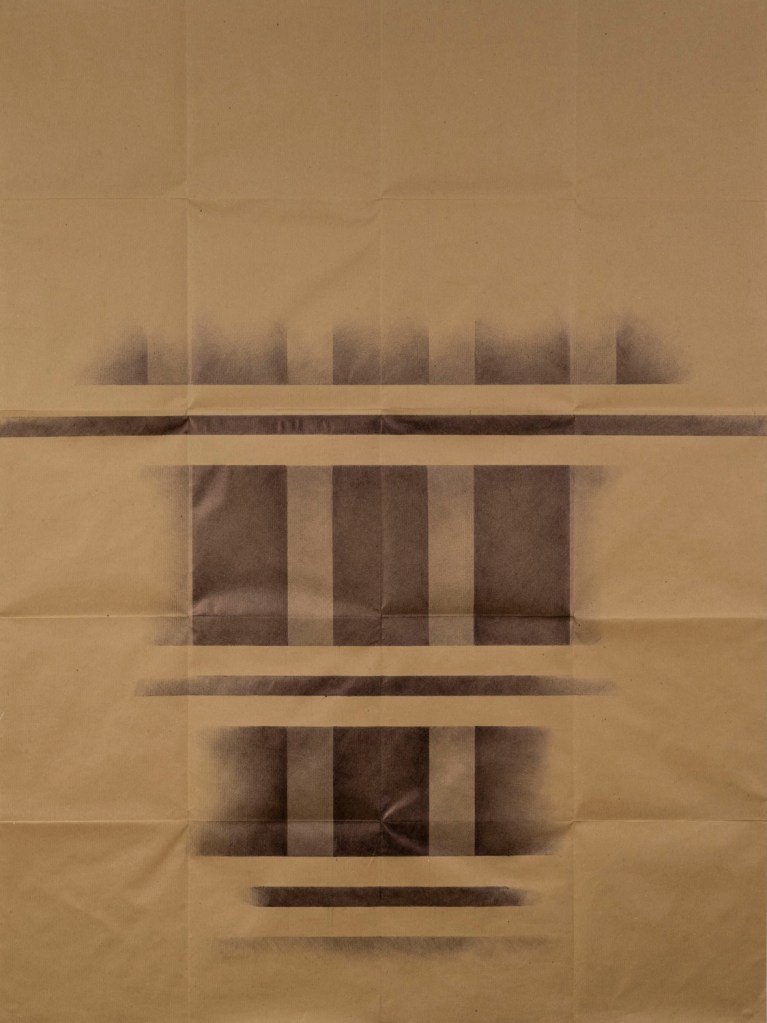
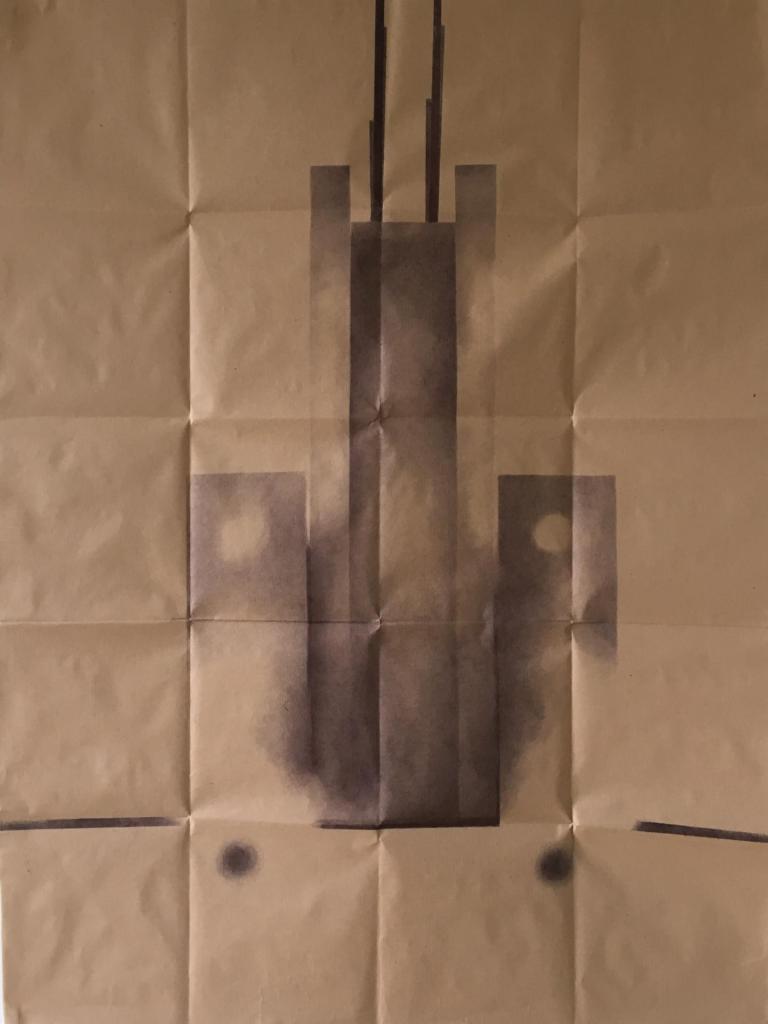
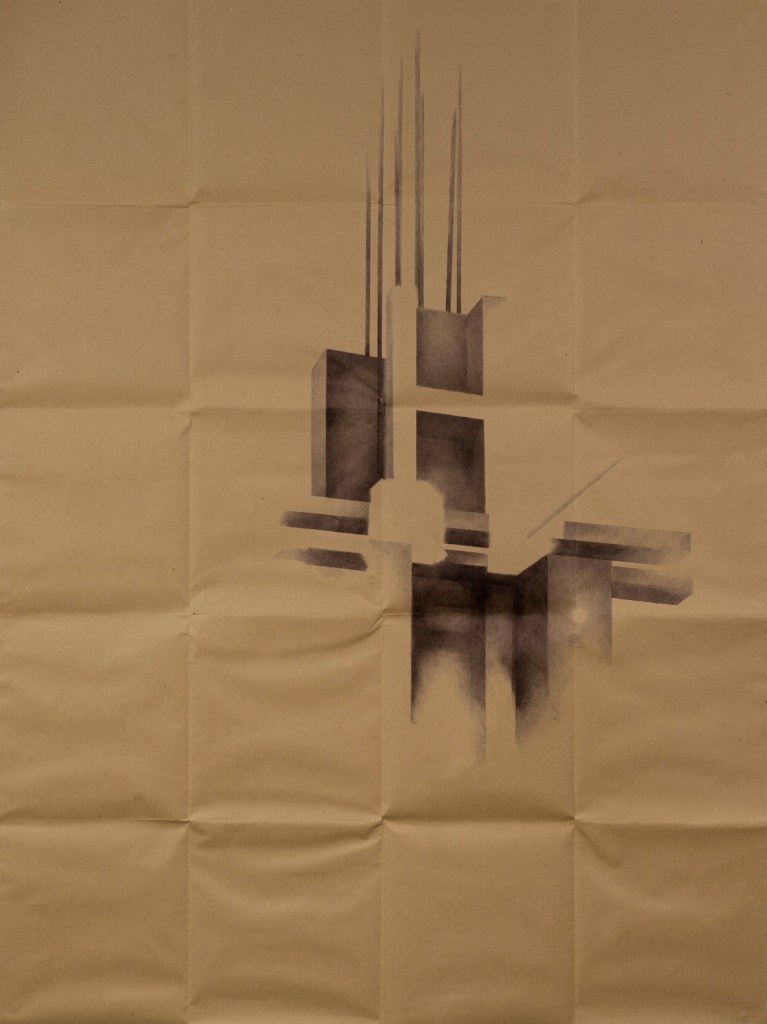
Each drawing measures 100 cm x 70 cm.
As you can see there are two versions of Pillar #5 :the first one was lent for a group exhibition in Italy, Sentieri in 2018 and has been subsequently donated to the Centro Ricerca per l’Arte contemporanea who organised and curated the event.
Pillar #2 has been shown in the group exhibition Inside Job, at the Tate Modern in April 2018.
The series has been shown for the first time as a whole at IN-Habit, a solo exhibition that I have organised and curated in my apartment in London in December 2019.
The work reflects on a short lass of time where the pillar is taking shape, specifically the reinforced concrete pillar that is locked in the skeleton of our cities’ architectures, visible in the constructive phase only.
I worked on this particular phase, creating an ongoing process in the drawings where the subject never really looks completed, but it suggests multiple possibilities of extensions in the space of the sheet.
The drawings are made by pen which is my main technique, based on a slow process of intersection of perpendicular lines that allows me to literally build the subject stroke after stroke.
The folds organize the space in a structure that contains and opens the vision into new possible geometries. The folds permanently mark the paper creating a grid, an additional layer that overlaps the drawings with indelible lines.
The drawings open and close on themselves becoming alive objects or perhaps sculptures before getting framed, a further and final stage in the drawings’ lives.
Architecture is a constant inspiration, but the attention here is on the construction sites as that previous stage before the finished object. Construction is the process in action, is the ability to think forward and to make things exist.
Elmo rovesciato – Upside down helmet – March 2020
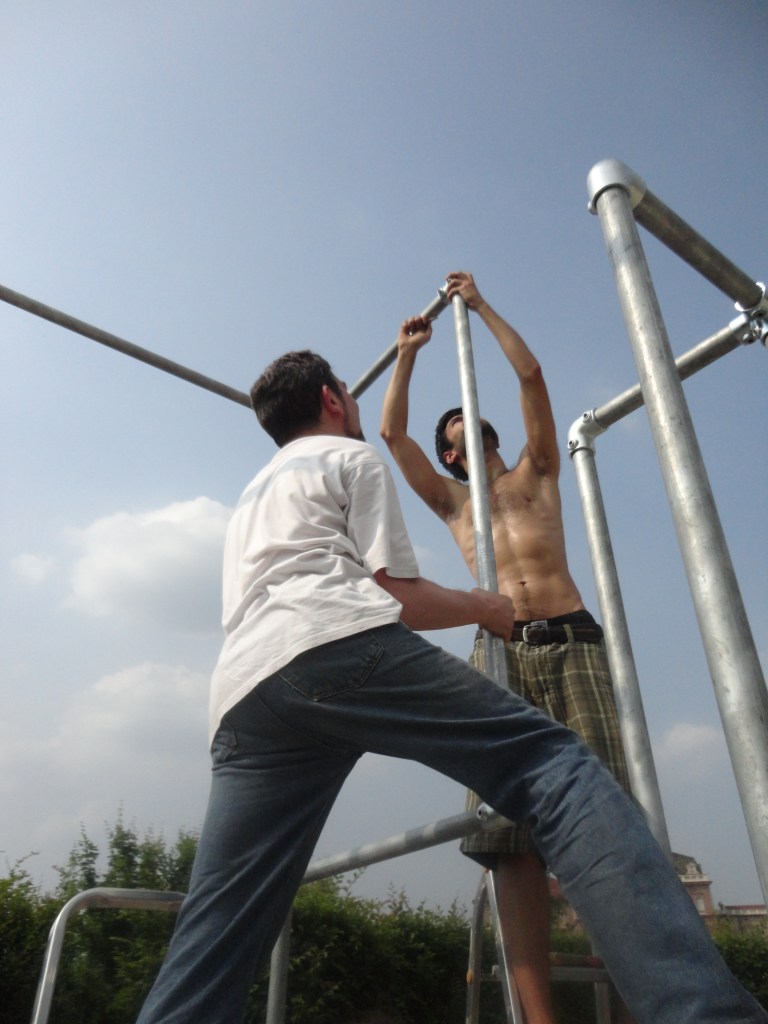
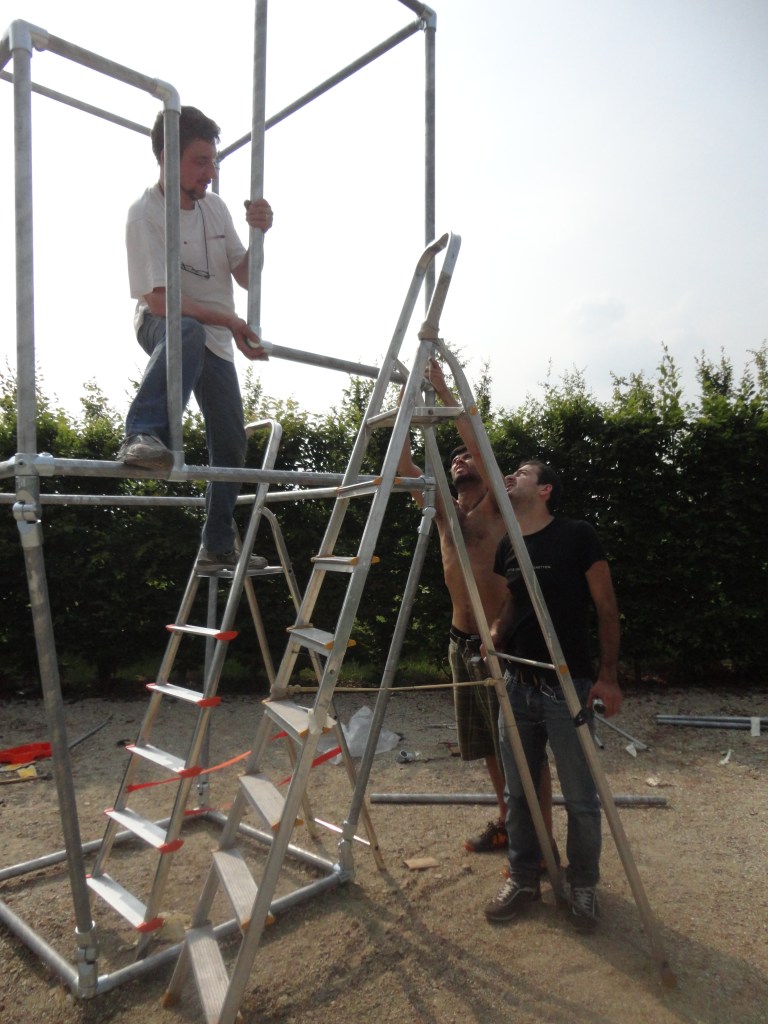
I recently posted a video on my Instagram account on the construction of my art piece Elmo rovesciato (Upside down Helmet) and I thought on writing some words about it in here as it is for me a very sweet memory of a work that I really love.
Elmo rovesciato is a big sculpture that I designed and built (with a lot of help as you can see from the video) in 2013 and it was the last work I made in Italy before moving to London the same year.
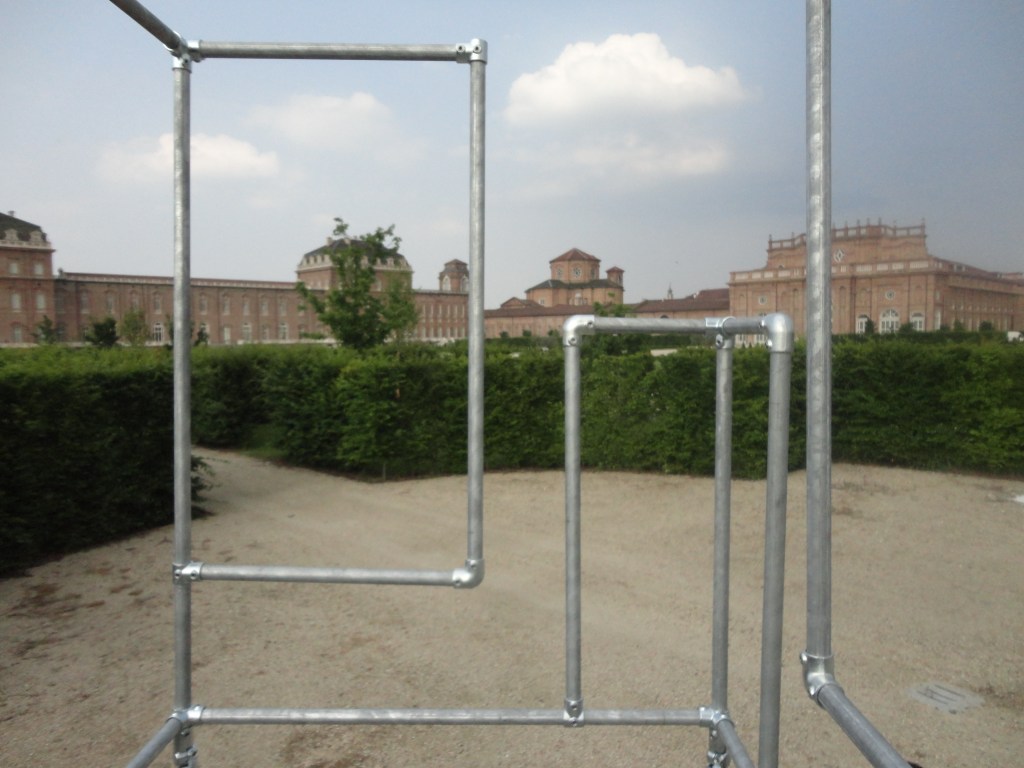
The huge helmet is 3 meters high (approximately 9 feet) and has been built with steel pipes and conjunctive joints bought from a scaffolding company. It represents the skeleton of a soldier’s helmet, but upside down. (Imagination required)
When I designed the object I wanted to create a structure giving it an ibrid idea of something that is taking shape (a scaffolding) but at the same time reminds the rest of something that already disappeared (a skeleton).
The pipes allowed me to bring my idea into life with a big metallic structure, almost a small scale architecture that was able to survive all the summer outdoors in all the weather conditions.

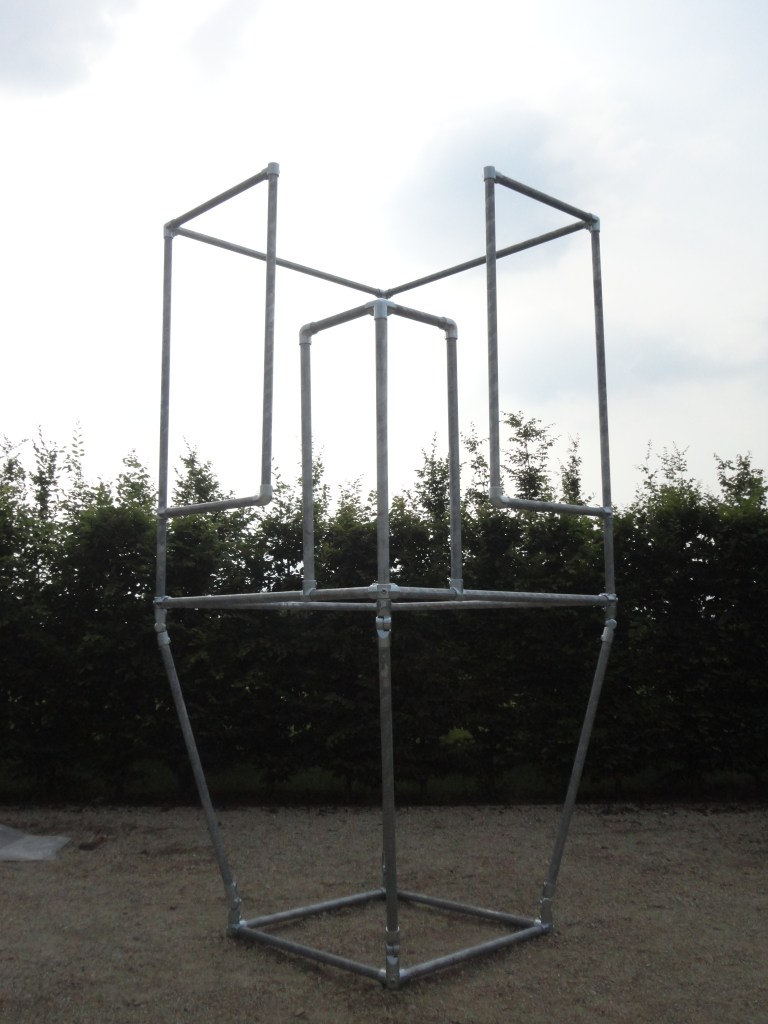


The idea of the helmet is connected with my interest in specific pieces of garments as representative in our western society. I chose to work on part of a soldier’s armor as a symbol but at the same time I wanted the helmet to be the only thing that survived from that soldier and I left only the skeleton of that.
The helmet is oversize as it is everyone’s helmet.
It is upside down also, but I still can not explain why. It just happened to me to think of the object that way and I decided to follow my instinct.
Elmo rovesciato took part in Art Jungle, a group exhibition in the magnificent gardens of the Venaria Royal Palace, beautiful Historical palace and museum just outside Turin.
The exhibition lasted from July to September 2013 and has been curated by Daniele Retti and Francesca Canfora.
The sculpture is currently disassembled and stored in my parent’s garage in Italy.
The work would not exist without my dad’s help with the creation of a building system.
Another massive help were my artists colleagues, my partner Alejandro Tamagno and my friend Ermal Rexhepi for the time they spent with me and my dad under the Italian July’s sun helping me to give birth to one of my weird visions.
See the timelapse video on: http://www.instagram.com/federica.beretta
Memories from IN-Habit – March 2020
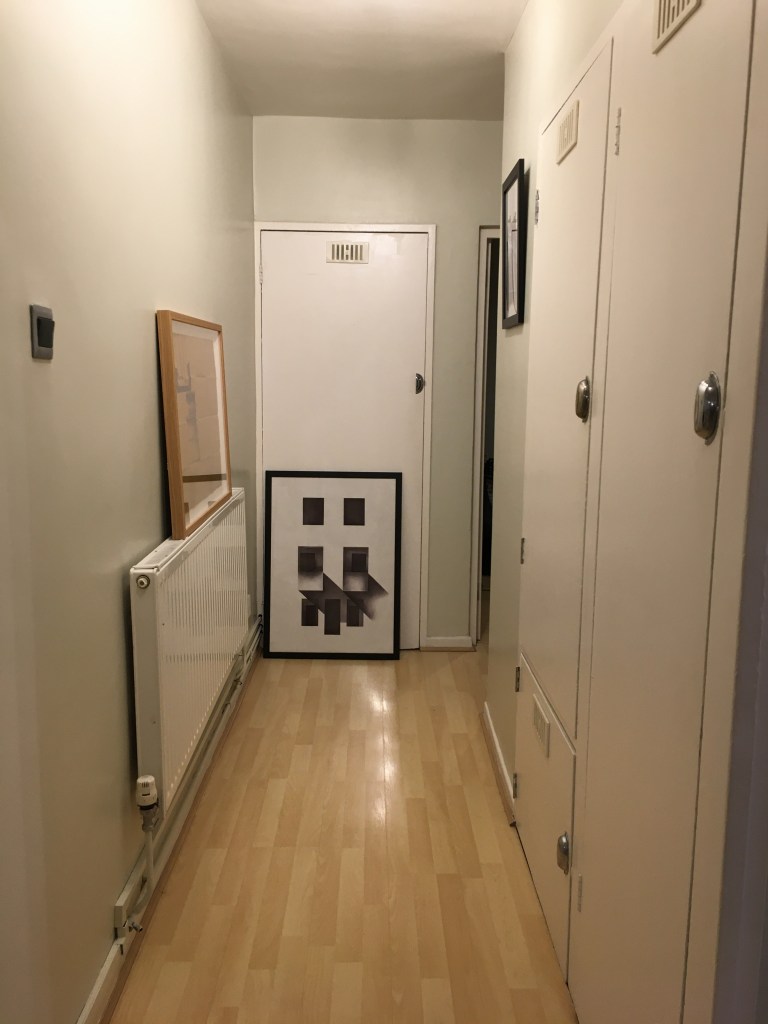
The exhibition was an opportunity to take all the drawings out from the drawers and the folders and show them in the intimate space of my London apartment. This operation allowed me to see my own work from a different perspective and to reconsider it, finding new interesting interpretations and linking new possibilities of further development.
I was impressed by the way my flat looked like with all my works on the walls of every room. It felt different as the exhibition managed to completely transform the space.
I decided to use my bedroom to show some sketches and the work in progress, in this way I created a limbo space where the process was the protagonist and where the visitor could get to know the different stages of my work. I used my desk, I hung some sketches on the wall and I also filled a cabinet with small pieces.


The living room was the biggest space and it hosted the main body of work: the series Pillars which I managed to show for the very first time to the public (and also to myself).
The series of 8 drawings took me at least one year and a half to be completed and being very big, I never had the opportunity to look at them as a whole. I was impressed and glad to be completely surrounded by them. I placed the drawings on the walls keeping only Pillar #2 on the floor, since it’s the only one framed as it has been previously shown in an exhibition (Inside Job- Tate Modern 2018).
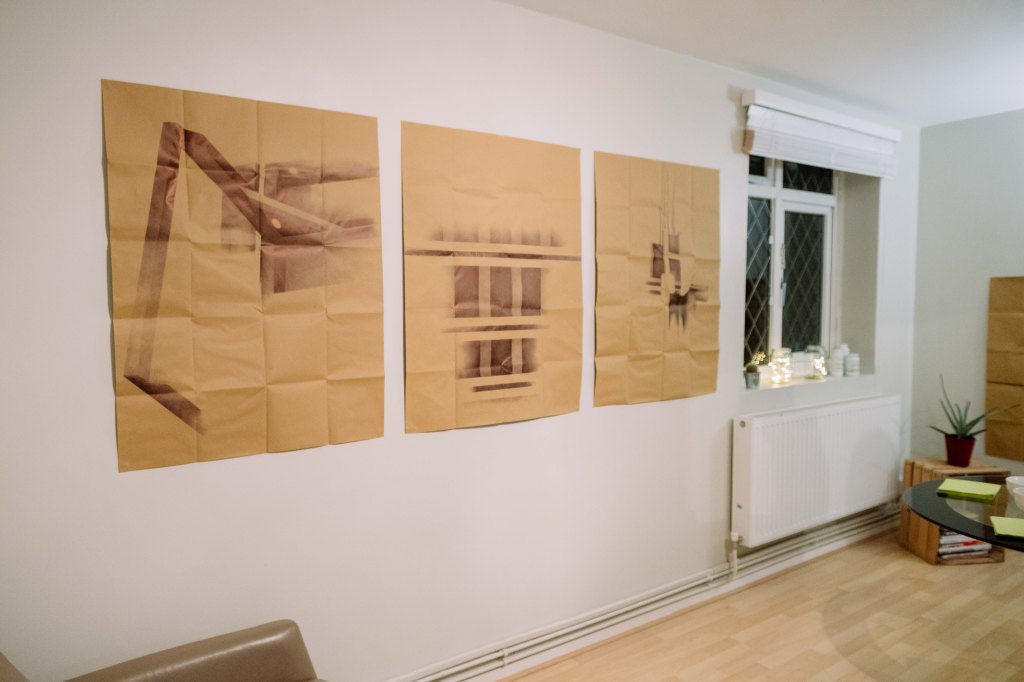

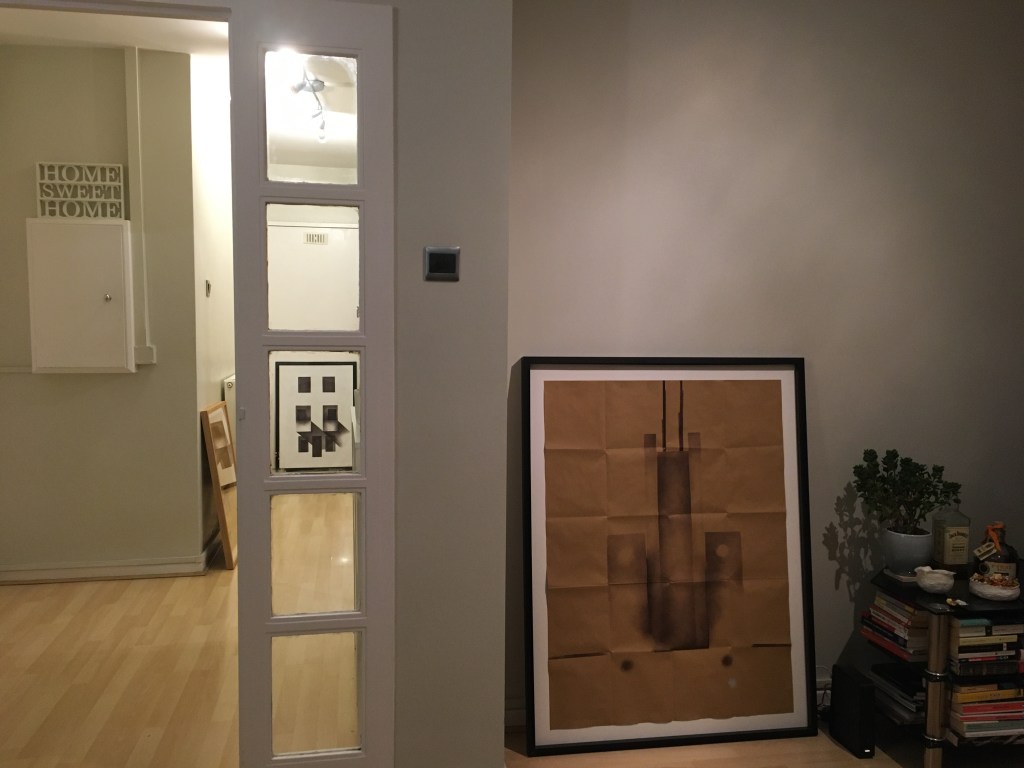

I decided to use the entrance to welcome the visitors with a drawing that has been started with the intention of being part of the Pillars series, but it became something else within the process.
The size of the paper, the subject and the technique are in fact the same used for the Pillars, but you can notice it hasn’t any folds, but a white flat painted surface occupies a portion of the space.
With this drawing I probably unconsciously moved from Pillars to some unknown territory that I still have to fully discover. I like to think of it as a passage, a way to move forward to something else and I placed it at the entrance: it was the first thing to see and a conjunction point as well as it connected the living room with the corridor.
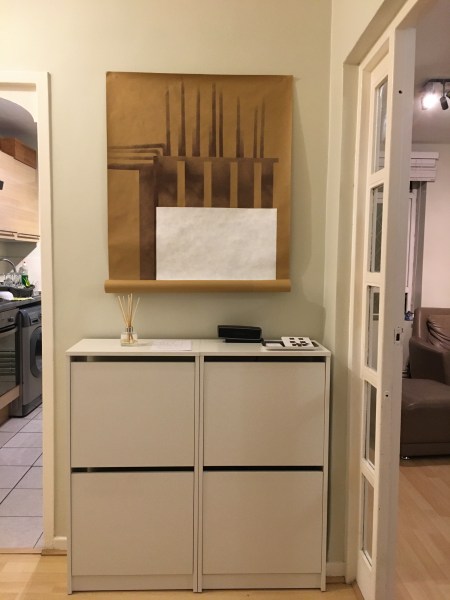
I really tried to fully use the geometry and the structure of the flat to create a narrative between the works in a fluid path where the drawings could dialogue between themselves and the visitors.
In the corridor I decided to show some small and medium size works from the past as a way to look at the roots of my practice.
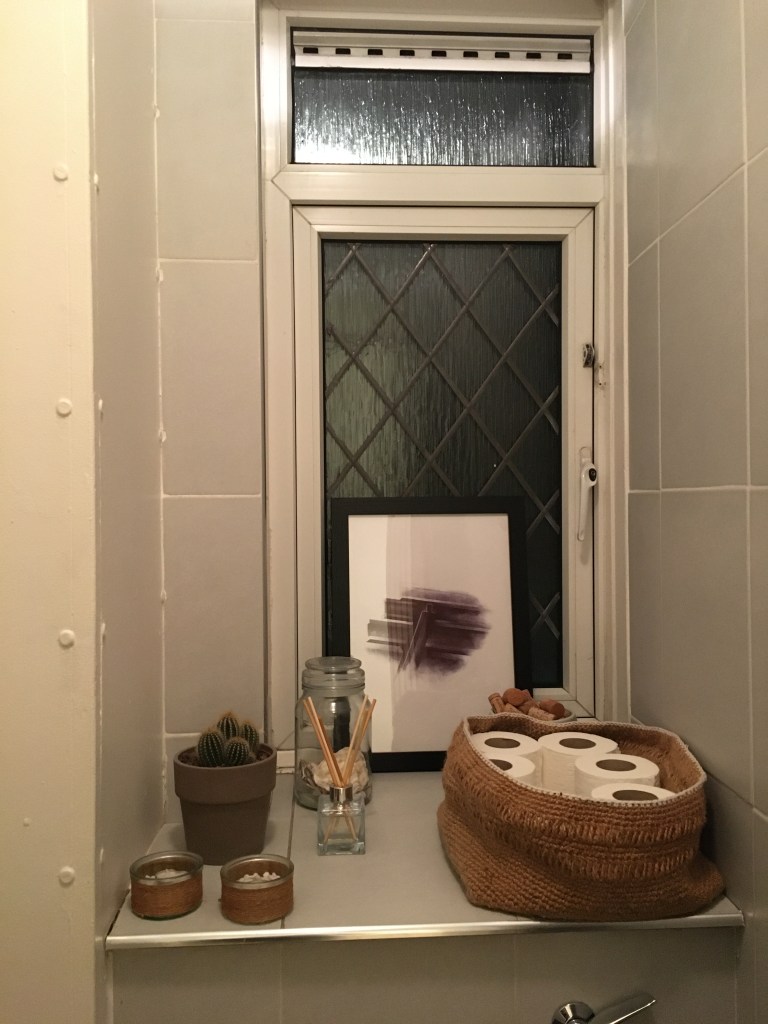
The corridor led to the bathroom that I used to show some other small framed drawings from 2015.

IN-Habit – November 2019
Please, join me for IN-Habit on Thursday the 5th of December 2019, 6- 8 pm, London

IN-Habit presents my work to the public in a familiar and intimate setting, a place in which most of the drawings on display were produced. There is an interesting connection between my working/living space and my practice, as most of the subjects that I address are architecturally inspired.
This exhibition looks at my productions and lays the foundation for the construction of future ideas with its nature of on-going project.
I am looking forward to welcoming you at my space for IN-Habit.
Opening hours: Thursday 5 December 6 -8 pm. Saturday 7 December and Sunday 8 December open upon appointment
Contacts: federicaberetta86@gmail.com | http://www.federicaberetta.wordpress.com | http://www.instagram.com/federica.beretta
RSVP: please, email me for info regarding the location
Inhabiting, being, existing, adapting, wearing, building, generating, transforming
With IN-Habit I wish to focus on the condition of being contained; to explore how it is fundamental to humans to be part of something from the inside. Inhabit means being actively part of a space and continuously transforming it, while reshaping ourselves at the same time. Humans are united as a species through inhabiting places: adapting to the space and adapting it to us, with a fluid movement in which content and container fit together.
Inhabiting, being, existing, adapting, wearing, building, generating, transforming.
Our habitats bond us and forge our attempts to make sense of the world. By adapting, we create habits and customs as a protection of our way of life. The artistic practice itself could be one example of this.
My practice always orbits universal subjects that we share as human beings. I reflect on our potential and limits as inhabitants and explore the condition of humans trying to break down the hierarchies and superstructures that we ourselves build.
Federica Beretta
Armour without body – November 2018
I started working on Armour without body at the beginning of the year, when on a short trip to Sicily I came across an abandoned house.
You have to imagine an early January sunny day, a suburb outside the main city, a quiet Sunday morning with noone around, me strolling along not looking for anything in particular. I found what remained of a building, not sure if the building had ever been completed or was just left undone and I was immediately attracted by the concrete empty skeleton.
My interest in that turned into this unexpected work on paper made with a black biro pen. It took me a while to complete this and I have to be honest, I did not work assiduously on it. I didn’t even know exactly what I was expecting from it.
Armour without body is a game of shadows and light, emptiness and fullness, in which I tried to use my personal technique to transform my vision of the subject into something else.
My interest in architecture constantly brings me to think of the buildings and their presence in the space. I see them as bodies, who we inevitably have to come into a relationship with. I talk about them in my works, about those visible and mute presences that surround and shape us and our lifestyle, the way we inhabit the spaces.
Inhabit implies moving, seeing, acting and caring.
Armour is an important and recurring concept in my practice and that is why I decided to insert it into the title. I wanted to create a connection and suggest a possible way to read the work.
I also would like my work to be able to express something itself, no matter the final interpretation.
This is a constant objective that I impose on myself every time I start a new project. I am not sure if I will ever reach my goal, but this is art for me: endless work in progress.
#The project is the work.

Inside Job – April 2018
Inside Job is the Tate’s staff exhibition and it will opens the 6th of April 2018 at Tate Modern, in London. It will stay on for the entire week end on the 7th and the 8th of April.
The idea is showing the art of the Tate staff. Most of us are in fact artists, designer, performers, and we are all bound together by the fact of living in one of the most expensive city and dividing our time between working and doing art. Working at the Tate is the connection that binds together artists working on different media, coming from all over the world and belonging to many departments at Tate Modern, Tate Britain, Tate Liverpool and Tate St.Ives. This is a great opportunity to see what is happening in the artistic scene outside the contest of the art market and commercial galleries, exploring who is part of one of the most beautiful and important museum of the world as a members of staff. I think this is an interesting point of view, revealing the behind the scene of Tate and what is going on with the creative class of the contemporary society.
The exhibition will take place in the amazing space on level 6 of Blavatnik Building which is the new extension of Tate Modern opened in June 2016. It is open for the public Saturday the 7th of April from 10 am to 10 pm and Sunday the 8th of April from 10 am to 6 pm.
In this occasion I will show Pillar #2 from the Pillar series started in 2017.


Sentieri – March 2018
I am very glad to write about two upcoming group exhibitions I am taking part with my work. I feel I am currently taking lot of strong decisions for my life, as an artist and as a person. The fact that this two opportunities of showing something came at this very moment, it is an encouraging sign for me to carry on with my work, despite all the adversities.
I have spent the last year divided between a full time job and a long process of drawing during my days off or any spare time. I have started a new series of drawing in 2017 and I have the opportunity to show two of them in two different contests, cities, countries. I think this is a happy coincidence that allows two of the works that were already born as part of a big series, to travel and to potentially connect to each other from two different perspectives.
The first exhibition I would like to talk about is Sentieri.
Sentieri is a group exhibition that will open the 30th of March in Amelia, Italy. The exhibition is curated by the artist and Professor Claudio Pieroni and is aimed not only to show works of emerging artists but also to create a dialogue between them and their works with the terrific location of a small city in the heart of Italy. Amelia is the place where the event it is going to happen: its churches, its ancient romans tanks, the hallways of its ancient noble building. The still visible past of this small town in Umbria is the connection point that tie together the artworks of 34 artists with the concept of Sentieri (footpaths in english).
The idea of working on a place that was the the intersection between the silk road and the franchise route, is very poetic and allow the artists to lose themselves in a pure artistic speculation.
Claudio Pieroni, artist and curator, thought this as the first of a series of events and I am really proud of taking part of it, leaving one small footprint on the upcoming footpaths/sentieri of art.
I will show one of my most recent drawing of the Pillar serie: Pillar#5 that I made at the beginning of 2018.
The press day is on Thursday the 29th of March 2018.
The public opening is going to be on the 30th of March 2018 from 12 pm at Piazza Giacomo Matteotti (in front of the town hall).
The exhibition will be open until the 30th of April 2018.
Definitely worth a visit.
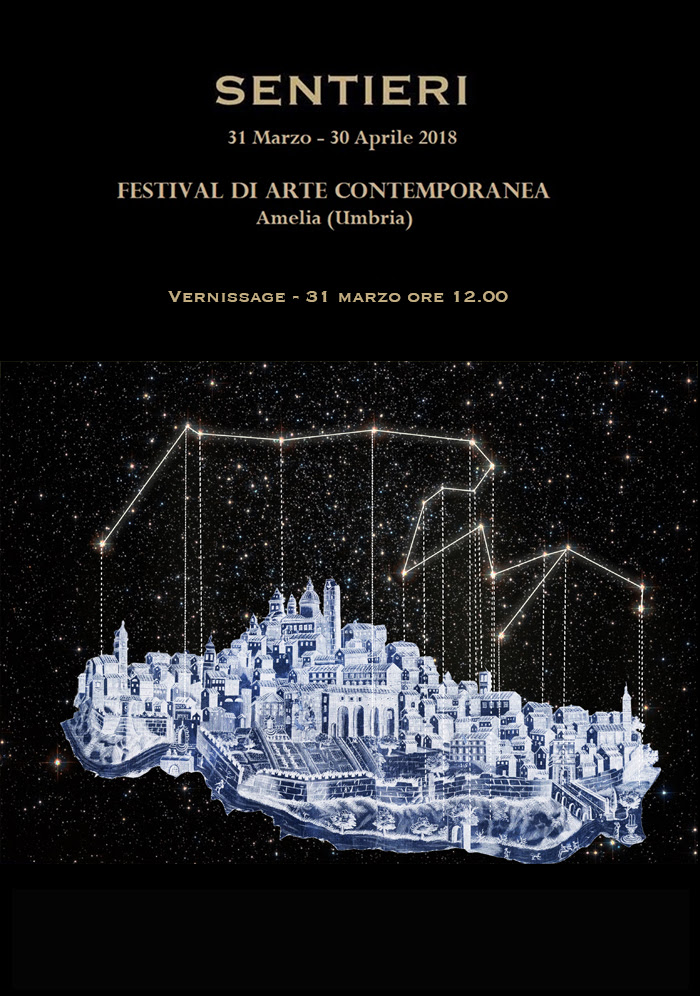
Sentieri is organized by Centro Ricerca Arte Contemporanea directed by Claudio Pieroni in collaboration with Associazione Culturale Feng Huang directed by Luo Guixia, with the patronage of Amelia municipality.
The Monk – March 2017
The Monk is a survivor and a witness.
He emerges from the picture, between the folds of the paper.
The folds of his robe mingle with the geometries of buildings. The tangle of lines builds the image and lets it disappear.
The fold is essential, the fold is the drawing.
The fold is the structure behind and over the pen marks. It regulates the space of the sheet shaping a grid, an “ideal” but visible grid.
The grid is real and overlaps the drawing, becoming part of it: it surrounds it and
it frames it.
I have started to work on Constructive Visions in 2014 when I moved to London and this work developed in a series of drawings over the years. It is now for me a sort of invisible box where I can theoretically place my pieces.
Constructive Visions was born with the idea to investigate the concept of construction,
as an evolutionary concept.
I think of construction as a process inherent to the nature of the human being, as a way to evolve and move forward. It is a way to give shape to an idea, as the artist
does.
The appearance of the drawings is always incomplete and the main inspiration is the city where I live. The city as a universal dress that shapes our existence and regulates our lives. I focus on the construction sites as places of knowledge and of action: as filters through which I watch and I wonder, as an artist, as an inhabitant, as a human being.

Le metamorfosi dell’ Io – December 2016
The upcoming group exhibition Le metamorfosi dell’Io, is opening tonight 14th December in the space of the XVIII century Barolo Palace in Turin, Italy. The elegant rooms will house 15 emerging artists’ artworks.
As artists we were asked to take part in the exhibition with a recent piece in order to compare our previous participation at Ars Captiva during the academic path.
I chose to display Two Tunics because I consider it an important step for the development of my artistic practice. This piece was shown at Progetto/Project my first solo exhibition in London in 2015 and I am glad to bring it to Italy for the first time.
I invite you to the opening of Le metamorfosi dell’Io tonight at 6 pm.
During the week you can come and visit the exhibition from Tuesday to Saturday from 3 pm to 5,30 pm. On Sunday from 3 pm to 6,30 pm.
The exhibition will be continue until the 8th of January.
The exhibition is curated by Claudio Zoccola for Ars Captiva.
Le metamorfosi dell’Io
Palazzo Barolo, Via delle Orfane 7, Turin, Italy.

Art and contemporaneity – December 2015
When I’m drawing I ask to myself what art really need to say and acquire in and from the contemporaneity.
I find in the practice of drawing the origin and the uncontaminated value of the artistic process and I keep on drawing, almost meditatively, waiting to understand what the society really need from art, and what art need to say in order to be involved in the contemporaneity of the events. Because I really believe that these two things have to be linked to each other.
I feel now like there’s a big gap.
I recently read Italian curator Luca Beatrice to affirm that the contemporary Italians artists are limps and too polite. They do not bother anyone. I would not contradict this statement, I actually agree with it and I also believe that I belong to this group of maybe too polite Italians artists.
But honestly, I do not feel the need either to produce annoying, aggressive, outrageous art.
Time change, as well as generations of artists.
In September 2015 a huge Jeff Koons’s sculpture Pluto and Proserpina, has been installed in Piazza della Signoria, in the heart of Florence. The sculpture is made of steel with golden surface, it is three meters high and weighs two tons.
I do not wish to dispute the artwork but I would like to focus on the words of a journalist who wrote an article about it in an online newspaper. The journalist states that it’s not important if the public likes the work, but it’s even more important if the public does not like it. In his opinion the work must be deliberately ugly and annoy with his presence in order to show that we are a country open to change (in Italy). The final thesis of the journalist is that the artwork should be installed permanently.
For the second time I found the same word: bother.
Why should art bother us?
These words scare me even more than the sculpture because they are the proof that a deep belief has been installed in our way seeing and thinking about art: a form of acceptance that still plays the role of provocation.
I think the last decades of history are quite full of this and as viewers we have been provoked and annoyed enough. We deserve a little more effort from the artists.
As an artist I think it’s maybe time to have a rest, take some time to think before starting to produce. I think that now more than ever, artists should take the luxury of the time to think.
I believe there is too much to say. I think instead that we must free ourselves from the burden of the past, and I am talking in terms of artistic language, imagery, method.
What I can see is a tired and anonymous art that lets itself forget easily.
A limp art, quoting Beatrice, I agree. Too commercial, easily to sell. Yes, in some cases.
Let me add that sometimes it’s ugly too. An ugliness that we do not really need.
We live in a contemporary world where the alleged civilization we believe we have acquired, mixes with the animal/human madness, that has always characterized our genre. This madness is still here, despite of the progress, despite of the culture. It is inside us.
Despite all, I am shocked when I think I am living in one among of what it’s supposed to be the most civilized countries, United Kingdom (or that anyway it has always felt the right to civilize other reality). This country recently decided to participate to a direct and official attack against another much poorer country with the practice of bombing.
Legalized mass murder. Form of absolute destruction. Fight against terrorism? …
This bother me and petrifies me more than an ugly sculpture. This led me think more. It gives me horror and disgust to realize than this is accepted and even considered indispensable for “the defense”.
The defense of the civilized West.
Contemporary is a viscose fog where we still have to understand who we are as human beings.
In this confusion, Art is alone; without anyone tell Her what to do, without commission, finally free, but without the need either to any revolution. To rebel against whom? In the meantime the market has totally taken possession of Her, dictating the rules.
There is not even room for doubt.
My thought is not totally nihilistic, because despite it all I still believe in the importance of art as historical counterpart, as fundamental element of the analysis. I do not believe in political art because I think it is pointless, but I believe in an art that reconstruct her own language and that reclaims her identity of poetic and analytic thought.
It’s because of that that I feel the need of questioning myself all the time.
Producing is a responsibility, in terms of meaning and in terms of physical space: what if the Koons’ sculpture were left in Piazza della Signoria instead to be removed, maybe because too heavy to move?
I think we need beauty, we need the time to observe, to think, to doubt. We need a reaction time that lasts more than a minute, we need to remember what we saw and perhaps feel the desire to watch it again.
We do not need to remain disgusted, shocked or even disturbed anymore by an artwork, because, if that’s the case, nothing can do it better than the manifestation of human folly.
http://www.artribune.com/2015/12/jeff-koons-scultura-piazza-della-signoria-firenze-dario-nardella/

TIAF 2015 – September 2015
I’m writing to invite you to the TIAF London 2015 art exhibition.
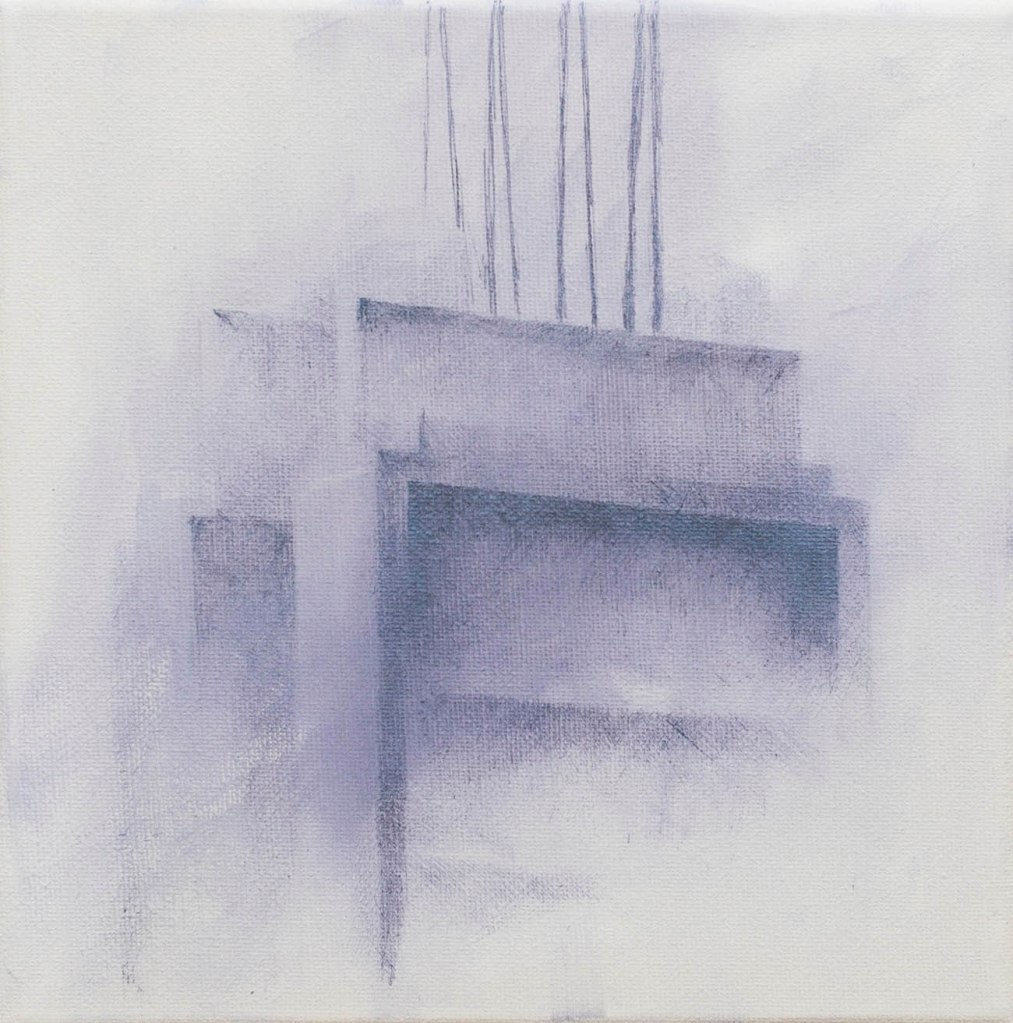
I will show one of my artwork from the series Constructive Vision. The drawing n3 was selected to take part of the event.
The exhibition will take place in the renowned Rag Factory, just off Brick Lane, only 5 minutes’ walk from The Other Art Fair, the Whitechapel Gallery and within easy travelling distance to Frieze Art Fair.
Private View: Wednesday 14th October 6.30pm – Late
The Rag Factory
16-18 Heneage St, London E1 5LJ
Open: Thursday -Sat 11am- 8pm, Sunday 11am-4pm
The Independent Artist Fair is a curated exhibition of 80 contemporary artists from across the world selected from 650 applications. The works include innovative sculpture, painting, photography, video, installation, music and performance from both established and emerging artists.
I’m looking forward to see you all.
I’m attaching the press release.

TIAF London 2015 Press release for distribution
TIAF London 2015 PR 1 for dist one page
Two Tunics – August 2015
I’m glad to finally be able to write about this artwork, because I spent a lot of time to designing it and I was very passionate about it.
The work consists of two big cotton garments that I decided to hang from the ceiling during the exhibition Progetto/Project, April 2015, London.
The two big tunics are the result and the new starting point, of my reflection about the dress.
My interest in this common object, comes from a curiosity with the symbolic and social aspect that belongs to it. I have dwelled on that form of visual power that the dress can acquire: the power of the individual over the community, a typical relationship in Western culture.
I like to say that this is a work on the Origin, because I consider it a universal reflection about the human condition, as something that belong to everyone.
I went back to find the first dress in history (of the Christian history). The tunics are an explicit reference to the two garments which God gave to Adam and Eve to cover them from their nakedness, in the text of the Creation in the Bible.
This was the first time that nakedness was considered shameful because of its association with sin.
The moment we first were dressed (as a genre) is the time when our condition as sinners made us mortals, and we had to cover our naked bodies.
I couldn’t help being extremely fascinated by the symbolic power of this object, and how the Christian tradition makes it a tool in some way.

I started to reflect on the dress as a symbol of the awareness of the human being in his new condition instead, and I associated this with the action of design.
In Italian the verb progettare (design) means moving forward.
The etymological research allowed me to think of this work as a constant work in progress.
So the Tunics in my work, born as a symbol of a universal condition, sin and death and how we get there from the Christian and Western tradition, are transformed into a means of knowledge, awareness and therefore creative drive.
I consider the action of design another form of power but as well one of the natural attitude of the human being to always move forward beyond its limits.
The Tunics are the result of this reflection about a form of culture: I worked on the concept of Origin and Double as a constant reference in Western culture (the one that shaped me). For me it is important to indicate it and work on the culture that has made an impact on my way of thinking, so as to give a point of view on things.
I consider it as two huge draft for my next works. That is why I decided to print on it.
On the male tunic I decided to print the pattern that was used for sewing the same tunics, this is like doing a step back and showing the design phase beyond the work. It shows the constructive project of both of the Tunics, so the project became the artwork at the same time.
It was very important for me to cancel the distance between the project and the finished work, because is a way to focus on the design phase as the thinking engine, form of power and way to survive our condition. That’s why all the pieces take on that aspect of the unfinished.
I like to think of each of the pieces of work as hybrid objects that reference each other constantly.
On the female tunic I printed one of my pen drawings. It was a way to open the work to a future experimentation. Furthermore, I liked to associate the idea of creative power to the female tunic, inserting a drawing that could be the first step for a possible new work.
On the female tunic I printed one of my pen drawings. It was a way to open the work to a future experimentations. Furthermore, I liked to associate the idea of creative power to the female tunic, inserting a drawing that could be the first step for a possible new work.


Process – June 2015
Process is one of mine artworks shown at the exhibition Progetto/Project (London, April 2015).
Process is an endless drawing that I continuously develop.
The practice of drawing becomes a method to think about the existence and the art: the process that precedes the product, the way you think about things.
To reflect on the process is a way to investigate a system of mental organization that brings the thought to the practice. It’s a study of the stage that precedes the creation of the artwork: the drawing becomes the the place where to structure the thought.
When I decided to start Process, I only knew that I wanted to do a very big drawing: now I consider this piece an important link in the chain of my art research.
Process investigates the mental space and the physical one.
Process is the method: is the way to intervene in a system of organization of ideas.
Thinking about the process is a way to analyze the mechanism of thought which leads to the formulation of the idea and its own construction.
The attention to the construction is constant: as the attitude of the human being to perform a certain practice of representation of ideas through the appropriation of space.
To build is like leaving a footprint, wield power over places.
The man who lives the space – May 2015
Think about the space.
Creating and sharing a ritual,
a Ritual that is part of human nature.
Think about the work, the method.
The process of geometrically thinking the space,
creating a system
able to connects the respective parts of the whole.
Human, in any situation
need to create a structure in which to be, think and build;
It is always the same continuous and enduring process.
Create the mechanism in which to exist:
physical space and mental construction,
is fundamental to the man who lives the space.
He builds conceptual structures and invisible signposts,
to define both the physical space and mental space.
He creates a system.
He follows the ritual .
The man who lives the space
shapes the matter, creates rules.
The method becomes ritual,
thought / action
ideal / real.
This is a text I wrote in 2013 when I start working at my new series of artworks.
I thought to publish it because despite the years, it still describes and represents my constant thoughts, questions and in someway my obsessions.
It intrigues me to think about the human being, or rather the human race as a specie to observe.
Art helps me in that, to analyze and deconstruct.
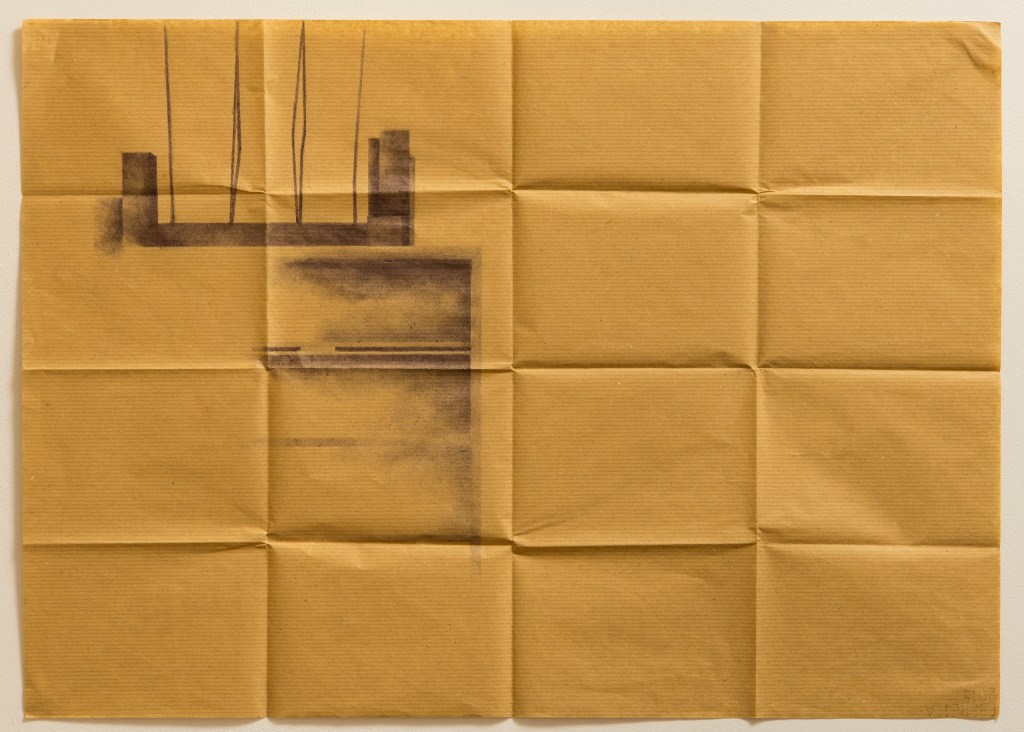


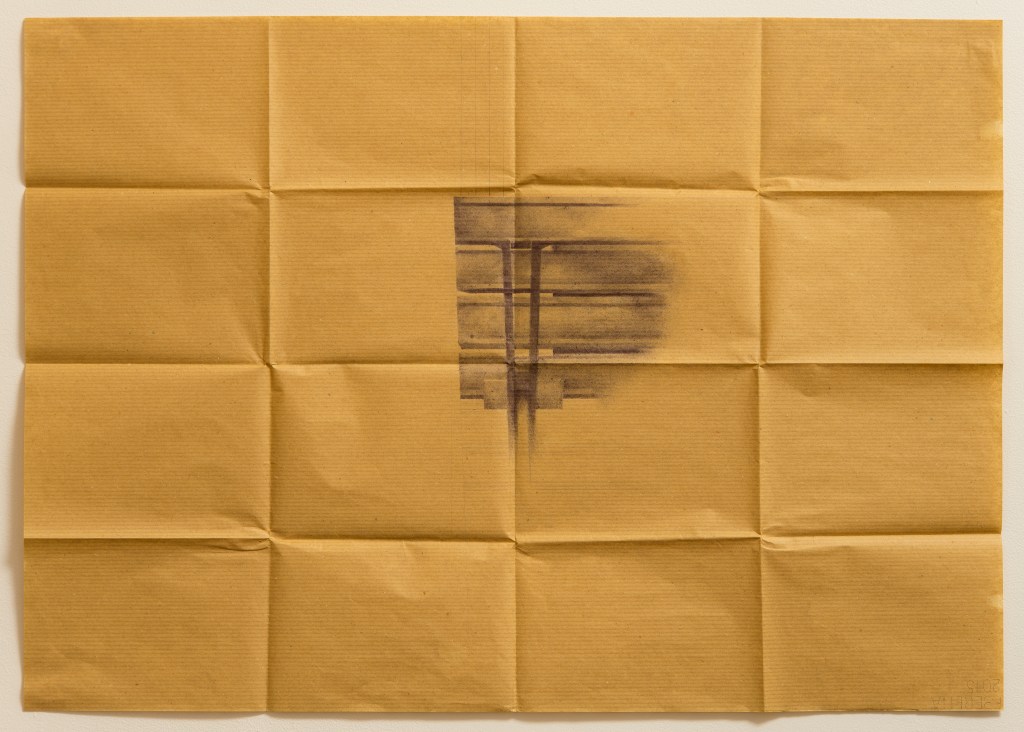
Constructive visions #2 is the second serie of drawings that I made with construction sites as a subjects.
They were part of progetto/project at my last exhibition in April in London.
The interweaving of pen lines creates a subtle network, a layer which remains incomplete and the folds of the paper insert in the composition overlapping the drawing as a rigid grid. The drawing is pure form and it appears on the paper as a vision.
I like to think Constructive visions #2 as an abstracts landscapes where the point of view is so close to the subject that it become almost unrecognizable.
The choice to represent construction sites s is a way to investigate the practice of architecture in its “primitive” stage: again, the goal is always to analyze what precedes the finished object.
I’m interested in analyzing the architecture because I consider it as a form of human power over places.
All the pieces present in progetto/project were born with my intention to represent the time of thought, the phase that precedes the work, any type of work: the phase of potential, when everything could happen, but nothing is done yet.
I consider this phase as an essential step in the human being life.
What is that thing that always drives us to go beyond what we know? Is it the pursuit of knowledge or the will of power?
Opening – April 2015
project (n)c.1400, “a plan, draft, scheme,” from Latin proiectum “something thrown forth,” noun use of neuter of proiectus, past participle of proicere “stretch out, throw forth,” from pro- “forward” (see pro-) + combining form of iacere (past participle iactus) “to throw” (see jet (v.)). project (v)late 15c., “to plan,” from Latin proiectus, past participle of proicere (see project (n.)). Sense of “to stick out” is from 1718. Progetto/Project is a way to reflect about planning, as a moment before the finished object; is the transition and construction stage prior to the implementation of the final work.
Project is a moment of absolute potential, and a continuous moving forward as attitude of the human being and of the artist as well; according to the Heidegger idea for which the human being is project.
I worked on the idea of artworks that would ideally work one as a project of the next one, following the idea of continues self-construction.
Project is the transition phase between the time of thought and time of finished artwork.
Is a work on the duality, on the concept of Origin and Existence.
It is a way to reflect on the nature of thinking man as a genre and as a result of structures that repeat itself constantly.
In this endless mechanism the artwork became a project and the project became artwork.
We are waiting for you tonight at 6 pm
The Chocolate Studios
7 Shepherdess Place, London N1 7LJ
Ring Flat n 21
Floor 3A
Progetto / Project – March 2015
After long time I can consider one of my work probably complete, (or I can say just started).
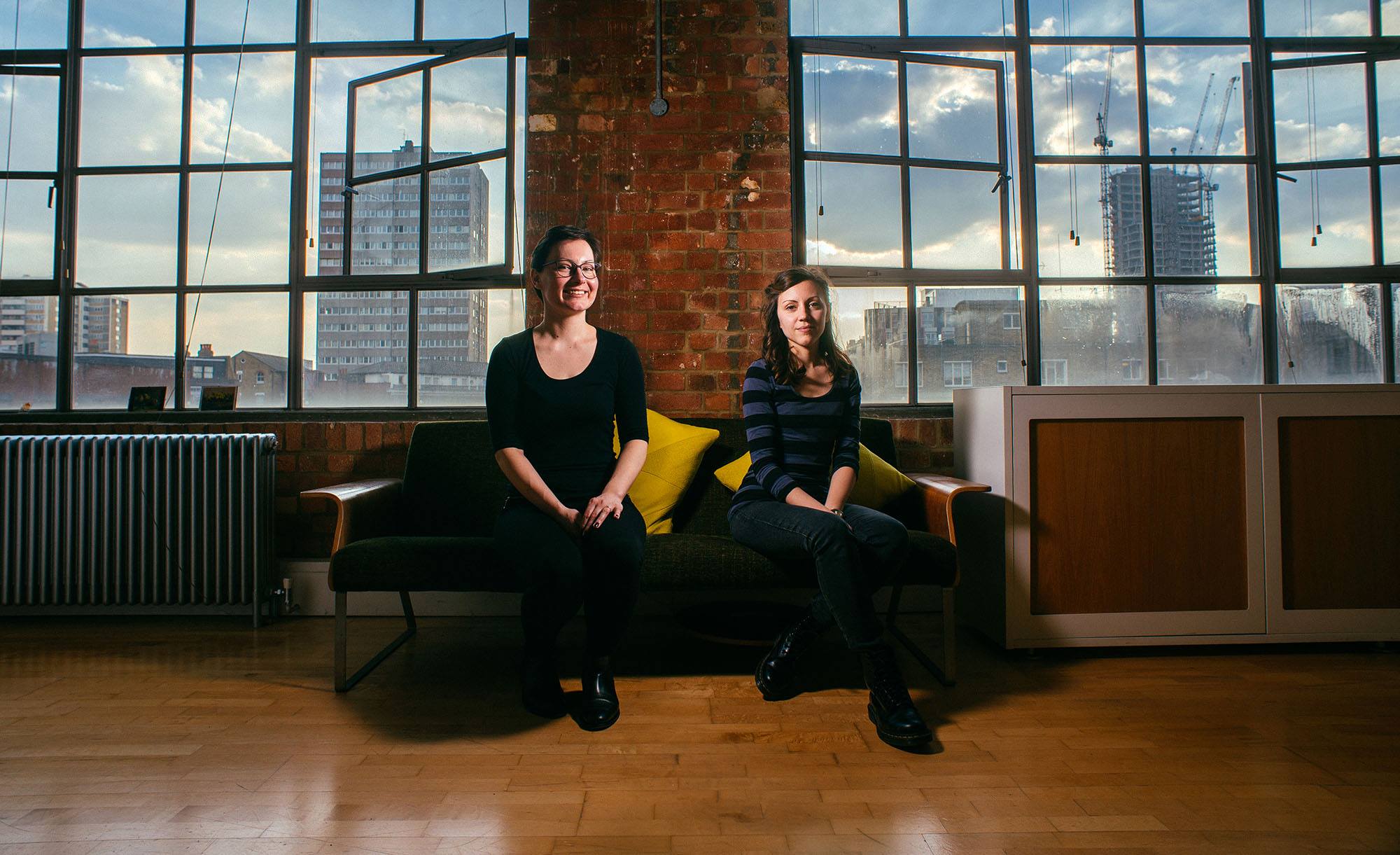
Project has begun at the end of 2012 and it took shape day by day until today. The design phase was very long and complicated. The work has changed several times, but it had the power to invade my mind for years and not to leave if not finally realized.
I didn’t expected to show it in London, because it was born when I still lived in Italy and my point of view was definitely different, but I’m quite sure that this city had influenced it greatly.
I called it Project because it’s a reflection about the process of realization of the things: the phase preceding the complete work or the finished object.
I liked to investigate the “moving forward” as an attitude of the human being.
And Progetto/Project resume this concept: the ability to design as a way to plan our own existence, to display objects, places, to think about movements and establish precise lifestyles as a ways to existence in this world.
My attention is directed on the process as time of thought and as time of building.
The work investigates the concept of origin with the dress as a specific symbolic object that reminds the moment of awareness, the duality as an inherited way to think, and the design as a way of organization of the thinking man.
I like to consider it just a starting point.
I’m glad to invite everybody to the opening on 9th of April 2015 in London.
and I take this opportunity to thanks one of my great supporter as well as curator of this exhibition, Kornelia Pawlukowska.

Build – January 2015
Constructive visions is a recent project, 2014.
The interest in the process of construction was born as a consequence of my research around the dresses and the habits of existence and it has developed when I started to think about the possibilities of the architecture.
When I began to work around the concept of power and the nature of the thinking man, I analyzed the dress as a symbol: identity, power and cultural affiliation, everything is connected and everything belongs to a precise system of cultural construction. The architecture has been the next step, a way to develop my research.I think at the architecture as an amazing practice and as a powerful medium: it has the power to shape the landscape, the cities, the people and shared public values.
In Constructive visions fragments of drawings emerge on paper as an incomplete imaginary.
I focused on the construction sites, to analyzed the origin of the architecture’s power in the first stage of its existence.
The practices of erecting place and shape the space are visible in the moment that anticipates finished building: the constructive action.
(Dall’abito all’abitare) From the dress to the dwelling to analyze the living space as the entire existence.
The relationship between the man and the space is one of the point of Martin Heidegger philosophy, as the way to think about the human being, time and space.He gave a speech called Building Dwelling Thinking during a series of conferences about the topic Man and Space in Darmstadt, Germany. It was the 5th of August 1951 and the 2 World War was just finished. His short essay is very deep and poetic and was a strong inspiration for my research about the possibility of the human being, and his existence on earth as the action of dwelling.Now it is possible to find the speech in the collection Poetry, Language, Thought.
Heidegger talks about dwelling as a metaphysical concept: “To be a human being means to be on the earth as a mortal. It means to dwell”. He talks about a poetic way to live that is not just to occupy space, but inhabit it with our passing presence.
That is the way my research has developed around the architecture as a sort of power and the power itself (suffered and practiced), as characteristic of our human nature.
“Only if we are able to dwell, we can build”and the action to build is directly related to the concept of care. To dwell means at the same time to cherish and protect, to preserve and care for.
Our “presence” is directly connected on a concept of responsibility.
Constructive visions are an uncovered skeletons, an unveiled process of existence.
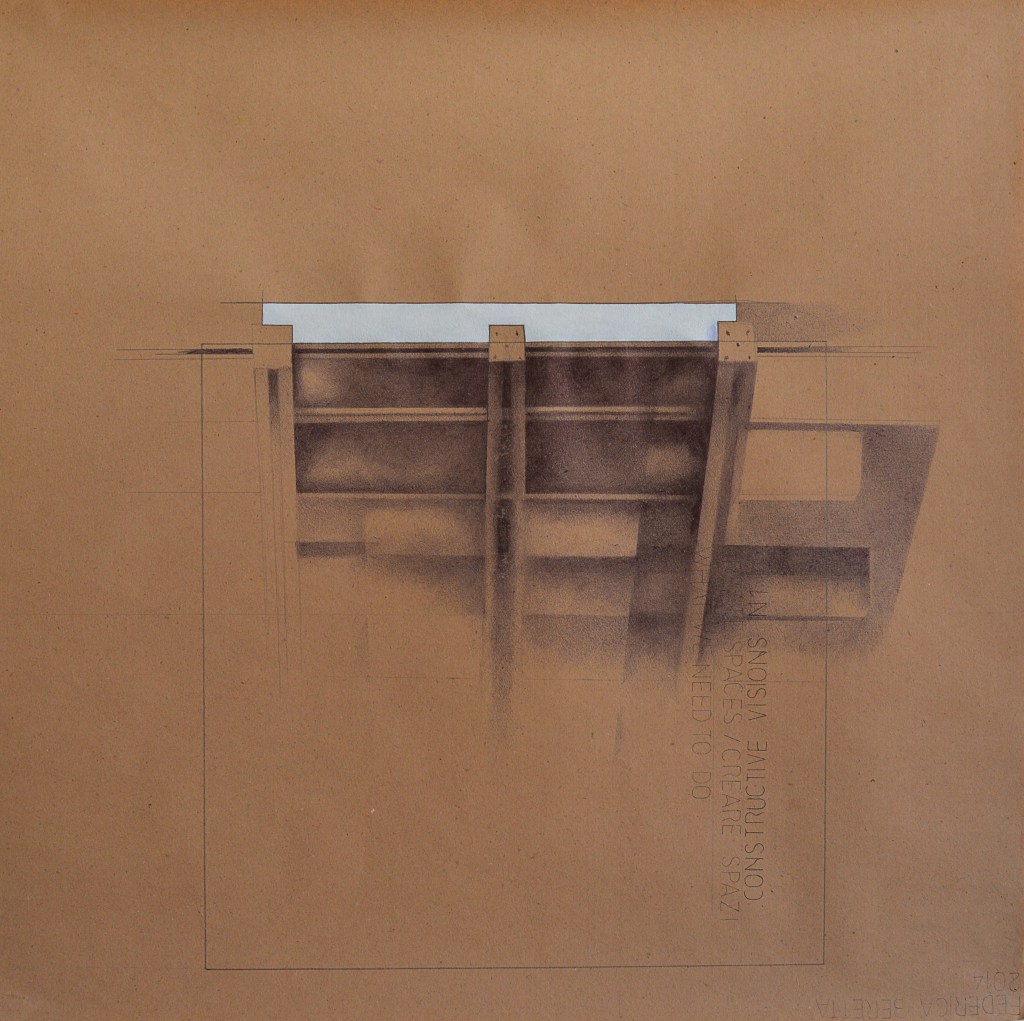


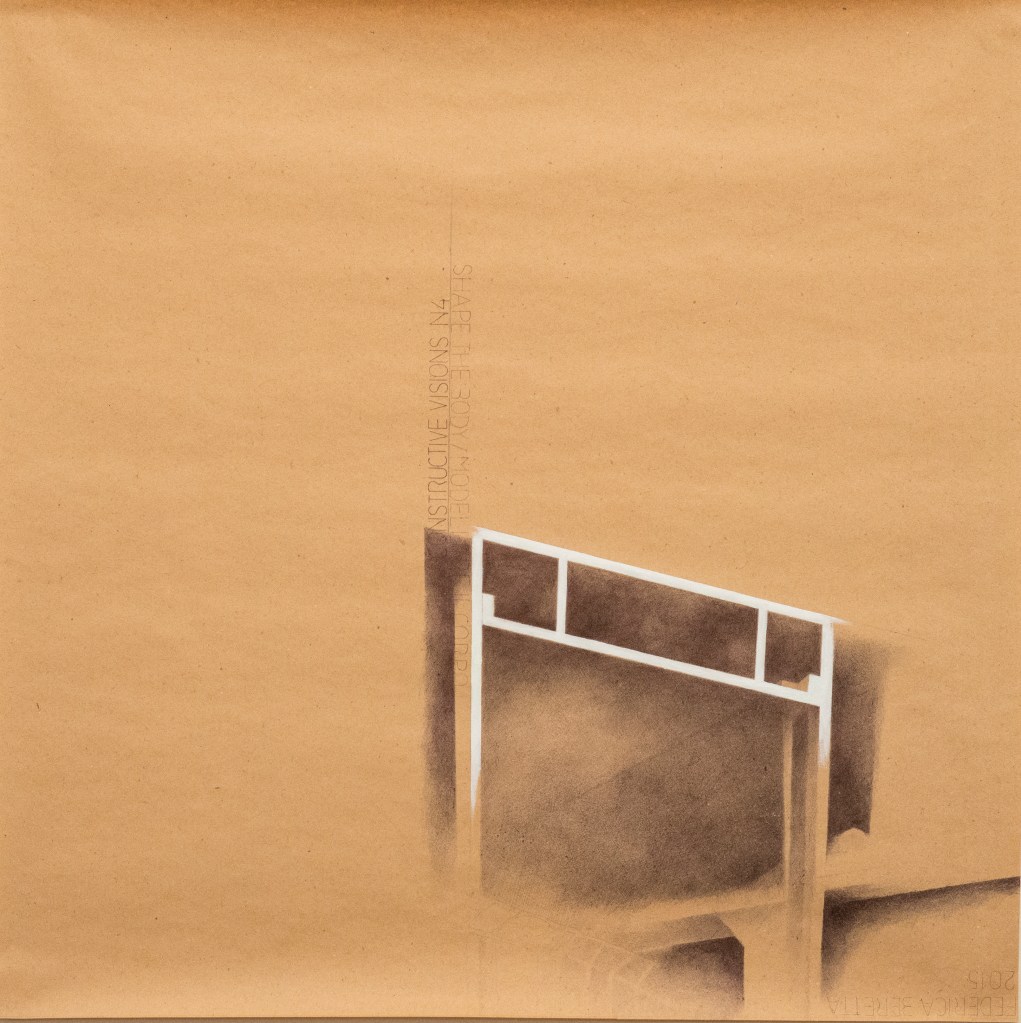
Structure – December 2014
I like to use the word structure to consider something both physical and theoretic.
I use this word because it makes me think of the skeleton of things.
When I made Helmet upside down in 2013 I’ve used the structure of the object (helmet) to talk about about something that belongs to the human being: the ability to build and to be built at the same time.
The choose to represent an helmet was a precise reference to a symbol of the military wardrobe. The cloth belongs to the man as the man belongs to his cloth. The uniform is made to make us aware of our role.
Living in society imply to absorb precises rules and codes and belong unawares (or not) to something bigger: a system, or a structure.
I could not help to notice, especially changing country, how heavy are the religion roots in a society’s structure. I’ve started thinking of that as the skeleton of our entire thinking system. Religion, but most of all to belong to a group of thought is something that shape the social structure, and as consequence the people. I think our behaviors and our ways of doing and thinking depend on the basis of religion that has shaped the social structure in which we live.
I’ve actually felt the difference moving in a country’s Protestant roots from a very Catholic country as Italy and then I came across with Max Weber. I had good results reading Protestantism and Spirit of Capitalism. This essay is a classic and it had confirmed and depth some of the “suspects” that I’ve gained during my research and that have strengthened living in London. I have been able to better understand the nature of a frenzy city as London, and the reasons why the economic system of the power of banks and profit could be linked to an old tradition of Protestant nature. Weber observed substantial differences between Protestantism and Catholicism and the resulting deep differences between the ways of life and the nature of the people belonging to one or the other religious education.
For instance Protestantism teach how the state of grace is something to gain only with hard work: if Protestantism promotes hard work to improve the life condition (it is always refer to an economic situation), Catholicism teaches acceptance of an original condition because the grace will come later on and not during life. Protestantism is focus in something that you can acquire during life to show your efforts in the eyes of God: everyone is able to increase their social status only with work.
Catholicism promotes on the contrary the detachment from all the property of a material and economic nature in order to raise the soul to a higher condition.
Weber theory explains how and why capitalism has developed more in Protestant countries and how the membership of a religious group has influenced the development of the attitudes of the people (and consequently of whole societies also from the economical point of view).
But mostly interesting is to notice how deep are this cultural roots if I can clearly see huge differences in attitudes and in the way we conduct everyday life here in England compare to Italy.
For example, the cult of the work was the first thing I noticed living here, and not exactly something you find in Catholic countries.
I really believe that the religious roots shape the social structure and as consequence our behavior and I found interesting reasons in Weber’s text. It as a very accurate analysis of how something that may seem a choose as religion, may have been essential for the making and development of the system of thought, and the way to act which we are accustomed to use.
Obviously I have very summarized the Weber’s theories, which are much wider, to connect my interest on the systems of thought that characterize social groups and analyze human nature.
To come back to the term structure, I use the concept to talk about something dept rooted in the human being nature as the membership, the identity and the habits as an expression of an acquired thought system, but I like to connect it with the physical structure of the objects that represent us someway. As symbol that we create to describe us.
For my sculpture I chose the helmet as a symbol of a power and of the body subjected to a power: the trained body and the image of the soldier.
The skeleton of the helmet is upside down as an old, consumed and forgot object, as a witness from the past. But at the same time I used metallic tubes and joints to assemble it, as a big scaffolding of something that still has to be built.
The structure is three meters and a half high and summarizes these two opposite processes.
Building is a gesture of active action that transforms the dynamics of thought in structures in which to exist, superstructures of existence in which we are endlessly inserted.
I like to analyze the process itself as the artificiality of the action and tireless attempt to fix the change to which we are subjected.
Build as create spaces is like looking for an order.
The space of the helmet explores the human nature, and the structure as part of an endless construction process.
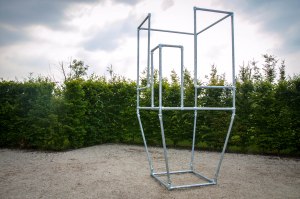

Body – November 2014
I grew up thinking the body and soul as two separate identities.
I have been taught they are two essential aspects of the human being, they live together, but one is only substance, the other one is something more, something that is going to survive over the life.
The naked body has always been something to cover up, to hide, something to be scared of, to mortify and to train, to keep under control.
When it all began, we were just unaware beings, nudes and immortal (according to the Genesis).
After the original sin nudity has become something to be ashamed of, always associated with fault.
Christianity is what has most influenced the entire Western culture.
When I write “naked body”, I’m talking about its functions; the whole series of drives, needs and pleasures that characterize the human being as a body, that belong to all of us.
When Michel Foucault wrote about the history of sexuality could very well described as the control of the body over the centuries it is needed, which is essential to adjust the society, to provide essential rules that would regulate the sexual aspect and hence reproductive, who worked as a check on the pleasure and functions of the body, he held that sexual relationships have created a “system of alliances” useful to create the structure of society: based on specific rules and categories about what is allowed and what is lawful (family and relationships, for example).
The categories and social groups to which they belong to, add the bodies in a system of rules and bind it to specific parameters to action. The regulation of sexual practices is part of this system of reorganization of the bodies’ activities and lives; process, rituals, practices of penance or resistance are made to punish and/or to train the body. They are aimed at an analysis of the body and its behaviors, as if the body and sex were two separate entities: to check, to educate, and if necessary, to adjust.
I think to the body as complex and powerful system whose functions and needs are to be investigated and I think to the thinking man as the engine of a huge creative power.
It is strange to combine these two aspects referring to the same thing: I refer to the human being as subject and victim of himself.
But the strangest thing is having to always get to think about things in a dual sense: is the most powerful and bulky lesson we have inherited in the West.
If something exist, it means that we can inevitably find its opposite, that everything has its opposite. That is why we can conceive body and soul, body and sex, naked body and clad body.
The duality that characterizes our way of thinking is rooted too old.
When in the Plato’s Symposium is Aristophanes’ turn , he tells the popular myth according to which at the origin, human being were compact beings with attached back and sides, with four hands, four legs, and neck perfectly round. They tried to climb to the sky, and for this reason were divided by the Gods. Since that time, men and women are imperfect beings whose nature is to seek their own half in each others.
In all the stories about the origin there is always a primal state of perfection that is interrupted because of men; than there is a punishment and a subsequent painful condition of life that goes with the desire to search something.
In Plato and later in the Bible, the human being recognizes himself in his nature to be sinful and imperfect, and spend his life to looking for something.
Aristophanes begins his speech with “I think that men do not realize the power of Eros (…)”
Is interesting to note how much importance has been given to sex, but above all to talk about sexuality, especially from the eighteenth century (according to Foucault). It has influenced the way of life and thought, and the strict methodology of control in relation to bodies. The need to define sex for such contracts proposed rules and organizational characteristics are a clear sign of how much power has been exercised for centuries on it, on our bodies and consequently in the way we think about ourselves.
Michel Foucault, The History of Sexuality v.1: the will to knowledge, 1976 (a suggestion for a great read)


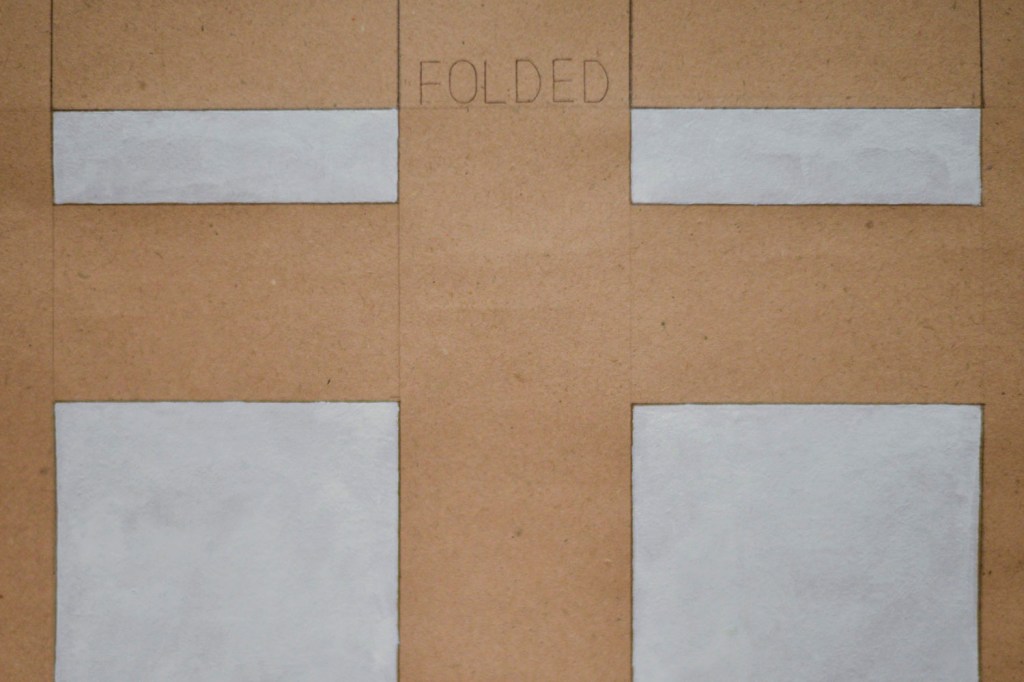


Habit – October 2014
We can use the word habit to talk about certain actions that are acquired during the life.
As human beings we tend to acquire specific mode of action and use them in a consistent manner.
Repetition is something inherent in our nature, a fundamental principle which marks the rhythm and timing of our existence.
Circularity is the structure of man that exists.
Is the habit a deep need of the human being? Is it maybe something almost physiological that belong to us?
There is a sort of mechanical nature that belongs to mankind, it make me think to the body as an autonomous reality, with its own set of rules and dynamics. As a small machine that constantly exercises its functions.
To be as being physical, involves the concept of body, because we can exist thanks to it.
We are a substance.
The body is one of my constant thoughts: the body as a subject, the coated body, the body accustomed to a number of principles, of rules, which becomes a power instrument and a medium.
Every society has a specific kind of rules and codes which the body has to get used to.
We can not help to belong at a specific system, we are the result (or one of the steps) of something that tirelessly repeats itself.
The questions I constantly ask myself lead me to face my research from mine specific points of view, especially concerning the concept of origin.
This is the reason why I use my education in a Catholic country and the codes with which I have been educated as a filter; because I really think that my ideas are derived unconditionally from there,or that I rework it through certain parameters that constitute my ideological background.
It is an almost unconscious process that belongs to us unconditionally.
The concepts, the symbol, the rituals that we learn during our life are something that come inside us so deeply; it is difficult to find an answer, to find the “true” between the limit that divides our nature of “thinking man” from the concept of “culture” as information storage, and the habits as provisions attitudes acquired through several repetition.
Can the culture become a cumbersome superstructure?
Analyze this limit leads me to a deconstructive practice and to look at every aspect as structures built with the purpose of supporting a physical but also mental system.
With this purpose for example, I had developed work as Construction kit, in which coexist the concepts of ritual, the cultural belonging, the dress as a symbol of power, but also as a collective recognition.
I like to work on the boundary between the activity of thought which belongs to man and the almost mechanical repetition of actions with which it confirms his physicality.
It is a way to talk about us as a genre.
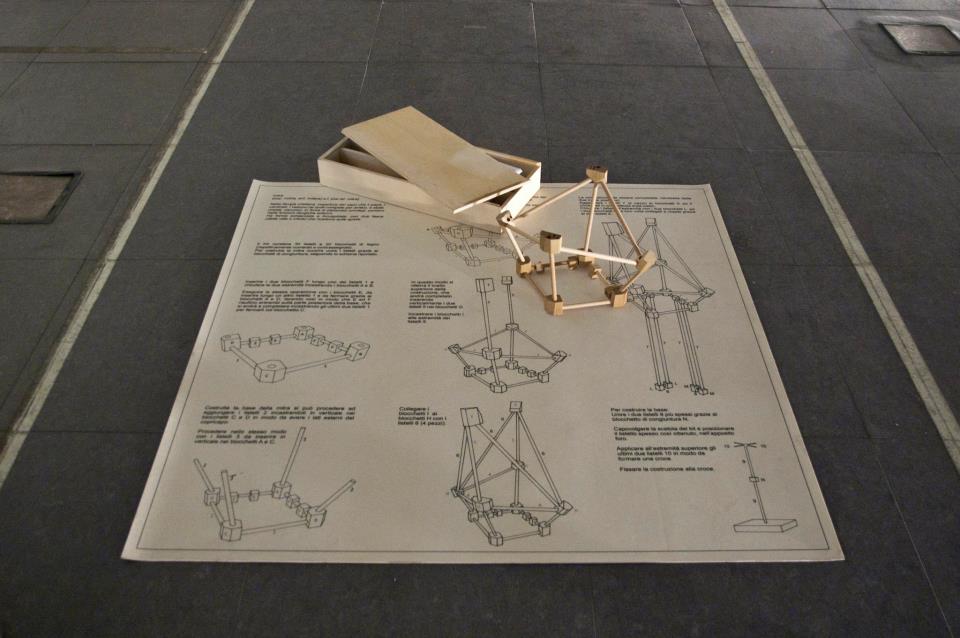
Interview with Kornelia Pawlukowska – September 2014
One of the nice aspect about living in London is that you can meet people from all over the world.
I met Kornelia Pawlukowska in an unexpected way. I answered to an ad on the web: some young curators were looking for artists for an exposition at the Metropolitan University of Arts in London.
After some exchange of e-mail I went to the Metropolitan University for a meeting with them.
There, I met Kornelia and from that moment we started to share our interest in art.
London is actually an awful place to develop relationship. Nobody has enough time to meet each other and the distances between places are massive.
But after almost one year we are still in touch and we are continuing to know each other.
It seems so weird that most of our conversation are via e-mail, but the time that we really spend together is always precious.
I have known one of the nicest people in her.
Kornelia is from Krakow and she is ending her Master in curatorships.
She is so clever and passionate. She loves art, but most of all she loves the artists and to spend time with them. It’s nice to see that her curiosity leads her to discover people and art all over the places.
I like her sincere interest and love for art and her constant energy.
These are the engine of her research work.
I attached the result of one of our precious conversations.
I would like to suggest you her interesting blog about art where you can also have a look at my interview.
http://korneliaviewsart.blog.com/interviews/
p.s. I forgot to specify that they did not choose me for the exhibition, but everything happens for a reason…
Abito – September 2014
In the Italian language, the word abito means at the same time: DRESS and I LIVE.
ABITO is an object and at the same time is the first person of the verb abitare, in English to live or better, to dwell.
This connection is very interesting, but the risk is to getting lost in the translation of the concept.
The English word that best embodies the meaning of this reasoning is habit.
I am always going to use this word also because it comes from the same Latin root: habitus.
The etymological definition of Abito is: the way of being, the disposition of the body and also of the soul.
Habit is everything that we are destined to bring with us all the time, like a luggage.
Habit is a state, a condition, a set of characteristics possessed by someone.
It is an acquired attitude.
This led to cues to my personal investigation about the habit as a casing, and about the being’s category.
I usually use this concept as a starting point for my reflections and my works.
Habit it can easily be a symbol or something that characterizes a particular group membership; what it interests me is to reflect about how it could affect our lives and our way of being and thinking.
How social structures and habits (intended not only as a clothes but also as a way of live) could have an influence on the way we think, we act and we live.
The flux to which the human being is hopelessly subjected contrasts with the search for a fixity of identity, whereby we need to synthesize a series of stimuli. We really need, as human beings, to create definitions, categories and theoretical groups.
The habit is a collection of ideas, is a vessel and a tool for the recognition between each others.
Habit is an useful medium to the comparison and can be a symbol to corresponds to an idea or an ideology.
From these assumptions spreads all my work.
The concept of “habit” implies many variations that are very interesting to me.
I like to think of it as a big container and as one of the ways to talk about the human being and about our own existence, trying to analyze the mechanisms that regulate its development.
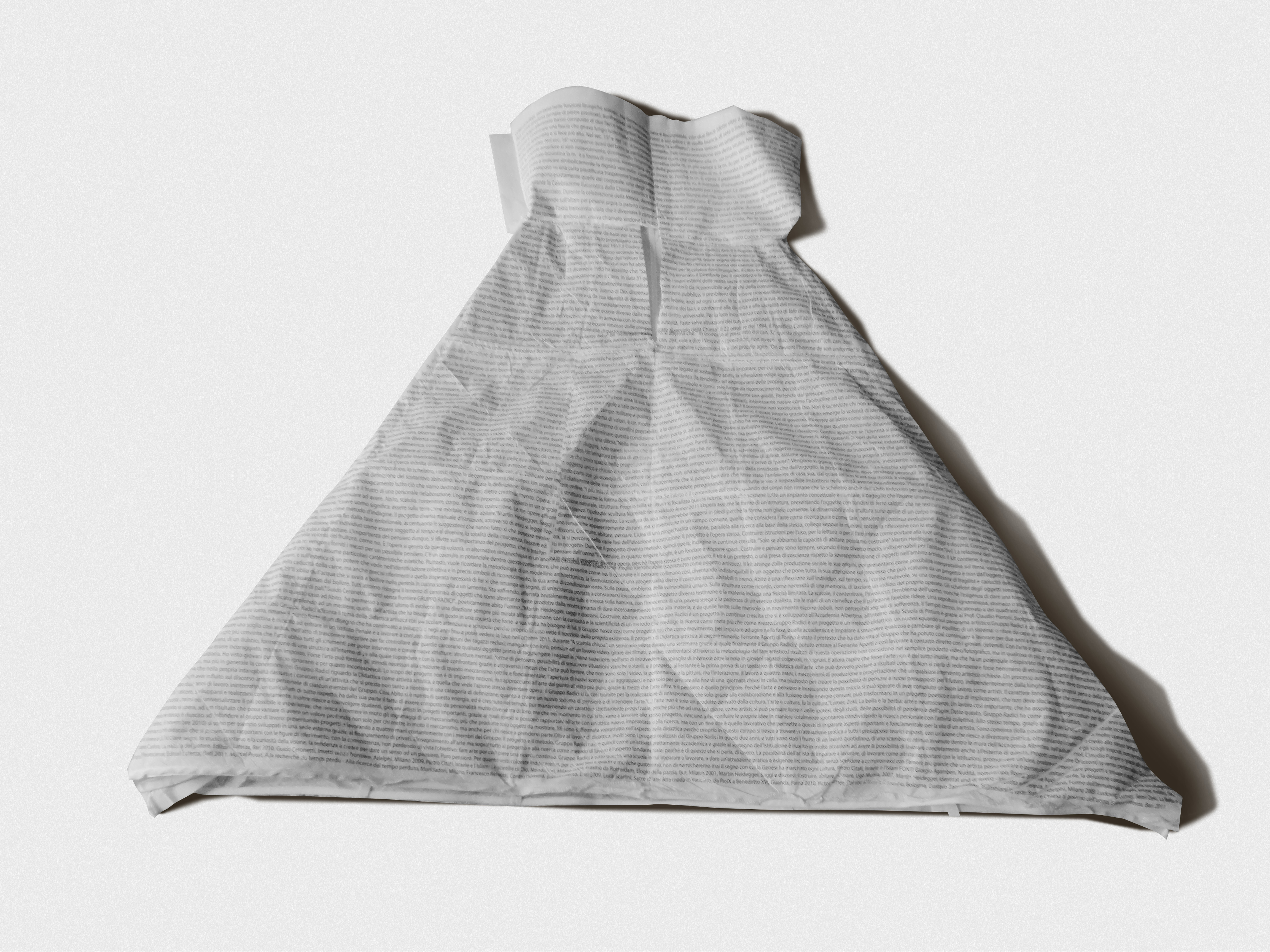
Getting lost – September 2014
I am an Italian artist based in London.
When I came here for the first time, in July 2013 I did not plan to stay long. My idea was to spend three or four months abroad to improve my English. More than a year has passed. Now I live and work in London and I really love this city. Honestly it’s not a simple place to live, but I like the energy of this city that never seems tired. It’s hard to describe the conflicting feelings that you experience here.
Sometimes you can feel so small, like an insignificant part of a huge machine, that could easily carry on without you. Actually, I do think that it works exactly in this way: nobody is needed in London, but don’t get me wrong, I do like the feeling of getting lost in the crowd and to perceive the loneliness of contemporary man. It is something that belongs to a life in a big city: amongst millions of people it is easier to feel alone.
Changing country is an important step for anyone, it could be for a short period or for years, but above all it means a change to your own point of view, which is essential. This has been and continues to be very important for me and for my art work.
I work by analyzing the structures and social mechanisms that characterize the human being and London is a very interesting place for research in these areas. I decided to open this blog to show my research and my thoughts.
My work is steadily under construction, a constant work in progress. I like to think of it as an open path, because since the start I have considered each piece to be connected to each other in a constant growth relationship. I like to think that each of my works has roots in the previous one, and it it is an essential step to the next one.
This particular report sets out and characterizes the way I work and I think about art: as a story it is destined to never end.

 federica beretta